First AI Baby Born: The World Didn’t Tell You.

Namaste, and welcome to Ethical Founder.
You know, every single day, we hear about the latest AI things, like ChatGPT or DALL-E. We all think, wow, the future is finally here! But what if I told you the “future” actually started a very long time ago? What if the First AI Baby wasn’t born last year, but way back, over five decades ago?
The honest truth is, the world’s first conversational AI baby is already here. And yes, most people totally missed the big news. Let me take you back in time so we can meet the real foundation of generative AI.
Stop Scrolling: The Real Birth of AI Happened Decades Ago
People commonly believe that generative AI, the kind that creates text or pictures, is a brand new discovery. That’s just a myth. The base for all the smart tools you use today was set up when computers were still huge machines that filled entire rooms. The main idea was simple but groundbreaking: Can a machine pretend to be human enough to just chat?
Meet ELIZA: The First AI Baby and the Start of Conversation
In 1966, a professor named Joseph Weizenbaum at MIT created a program called ELIZA. This was our First AI Baby.
What made ELIZA special?
- It was a simple, text-based program.
- It copied the style of a therapist.
- It used a neat trick called pattern matching to reply.
- It was truly the first AI as a conversational child.
For example: You say: “My mother is always angry.” ELIZA replies: “Tell me more about your mother.” It worked beautifully at the time.
The Simple Code That Shook the World: Early AI Technology Explained
ELIZA was a shining example of Early AI Technology. It didn’t actually “understand” your words like a modern human or even ChatGPT does. It had no real knowledge about life, feelings, or family. It just followed its script. The cleverness of ELIZA was its simplicity. It proved that basic programming could create the feeling of understanding. This is the main concept behind early generative AI.
To truly understand how amazing our First AI Baby was, here is a quick comparison with today’s big players:
| Feature | ELIZA (First AI Baby, 1966) | Modern Generative AI (e.g., ChatGPT) |
| Core Technique | Pattern Matching and Fixed Scripts | Complex Neural Networks (LLMs) |
| Data Size | Minimal, just the original hand-written scripts | Trained on the entire internet (Huge amounts) |
| Output | Basic Questions and Repetitions | Very Human-like, Original Content (Text, Code, etc.) |
| Understanding | Zero real understanding (Purely fake) | Advanced Contextual and Meaningful Understanding |
How a Chatbot Sparked a Revolution in the Role of ELIZA in AI
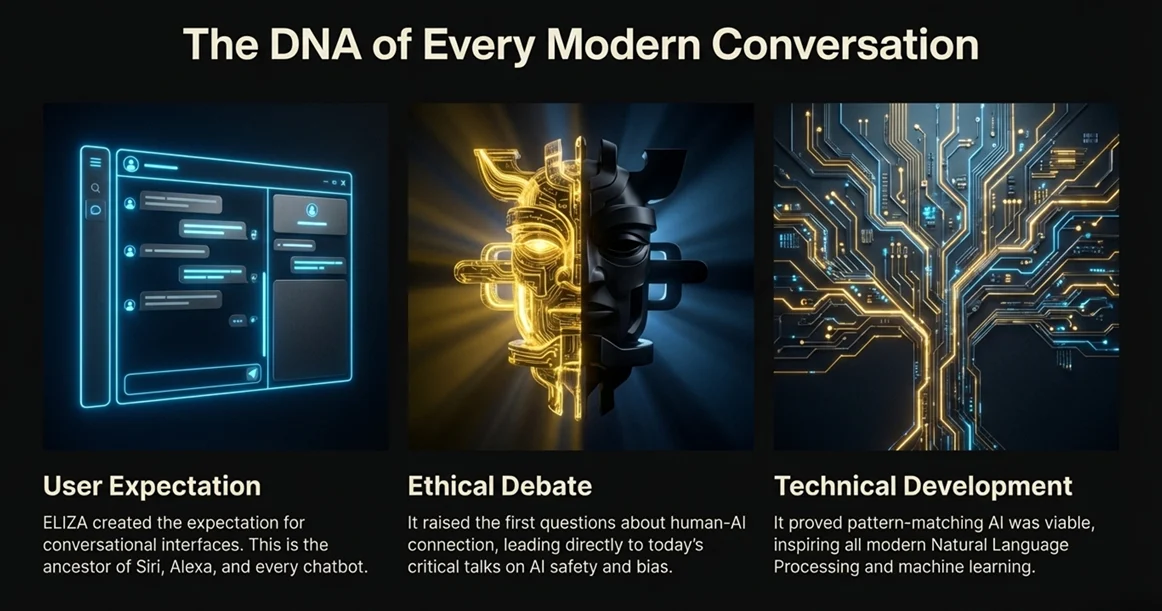
Even though the code was simple, the Role of ELIZA in AI was incredibly important. It was the first time people saw a computer talking in a way that seemed human. It proved that AI could be much more than just a calculator, it could be a friend or a communicator. Every chatbot, every smart speaker, and every modern AI system owes its start to this simple program. It set the stage for all future growth in digital data and chat systems.
The Forgotten Impact: Understanding the Psychological Impact of ELIZA
The most shocking part of the ELIZA story is how people reacted. Users started having deep, personal, and emotional talks with the program. Many truly believed they were talking to a real, caring person. They felt a strong bond. This huge Psychological Impact of ELIZA worried its creator, Mr. Weizenbaum, who became concerned about the clear lines between humans and machines getting blurred.
From AI as a Conversational Child to Today’s Synthetic Data
This original program, our little AI as a conversational child, taught us a big lesson. We are too quick to treat a machine like a person, especially when it talks back nicely. This is a very serious ethical problem that is even bigger today, because modern generative AI uses super-complex data to sound perfectly human. All these ethical worries started with ELIZA back in 1966.
The effect of this first conversational AI spread through the years, shaping the whole industry we see today:
The Future Was Born in 1966: Why This History Still Matters
So, why should the First AI Baby be important to you today? Because knowing about ELIZA helps you understand the tools you use every day. It tells us:
- To be a little careful.
- To always question the ‘intelligence’ we see on our screens.
- To know that even the most complicated AI is built on simple, brilliant code from the past.
The future of AI has always been about simulating a chat, and that long journey began many years before the news headlines.
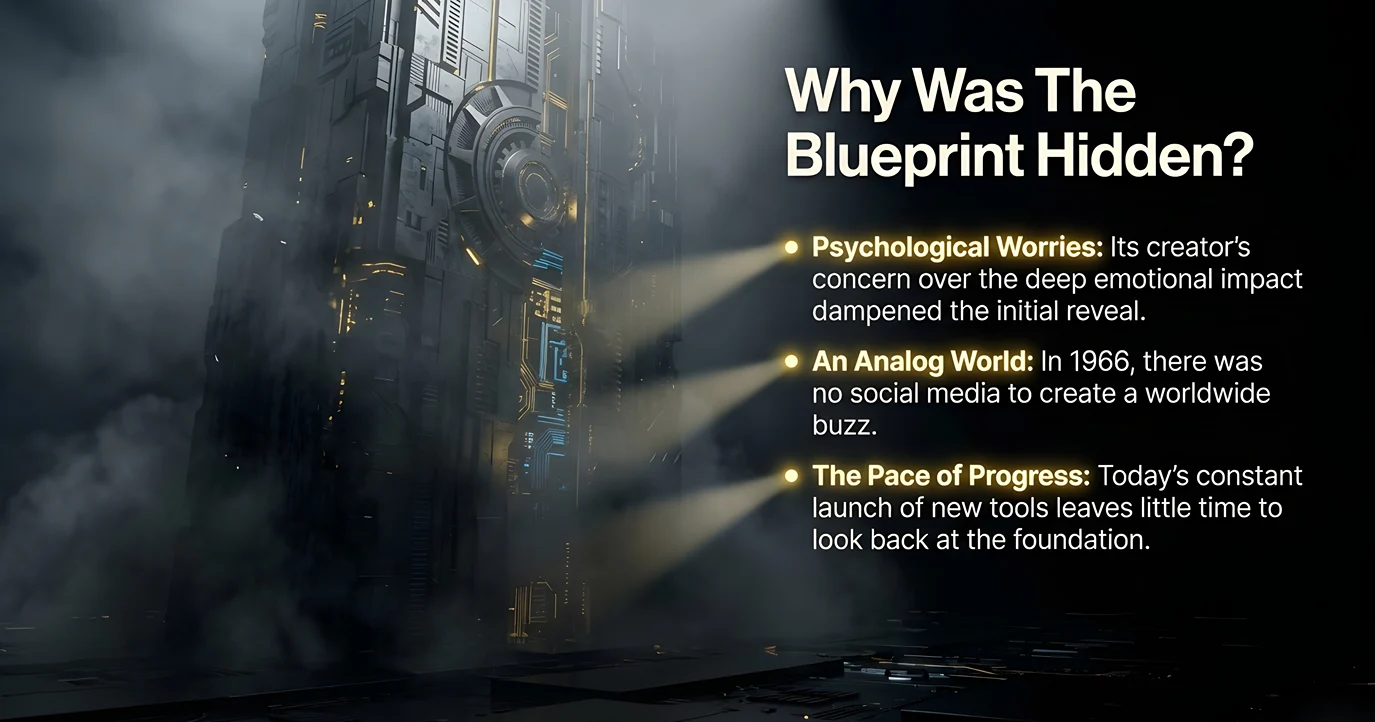
Why Was This AI Baby News Hidden From You?
The title says “The World Didn’t Tell You.” Why is that? Frankly, the birth of the First AI Baby in 1966 was quiet for a few solid reasons:
What do you think? Were you surprised the first ‘AI baby’ was born so long ago? Share your thoughts with us!