
About Us
The argument in favor of using filler text goes something like this: If you use real content in the Consulting Process, anytime you reach a review point you’ll end up reviewing and negotiating the content itself and not the design.
The HR Helpdesk Chatbot on Telegram I Build for Indian Small Businesses Without an HR Team
The HR Helpdesk Chatbot on Telegram I Build for Indian Small Businesses Without an HR Team
The HR Helpdesk Chatbot on Telegram I Build for Indian Small Businesses Without an HR Team
“Sir, how many casual leaves do I have left?” “When will salary come this month?” “Office Wi-Fi password kya hai?” If you run a company of 25 people in India, you have answered these on WhatsApp or Telegram more times than you can count, often late at night. There is no HR desk, so the founder becomes the HR desk. That is the problem my HR helpdesk chatbot on Telegram solves.
I built it with my team for Indian startups and small businesses with 10 to 50 staff and no one in HR. Employees message a Telegram bot in text or send a voice note in Hindi, English or their own language. The bot turns voice into text, searches your own policy PDFs stored in a Postgres database, and replies with the exact rule from your policy, not a guess from the internet. Below, I explain what it answers, every node on the path, why the order matters, what breaks, how to set it up, and how my team delivers it.
Why small Indian teams ask HR questions on Telegram and voice notes
Small Indian companies do not run on HR portals. They run on chat. Offer letters go out as PDFs on WhatsApp, attendance is marked in a group, and leave requests arrive as a message to the owner. Nobody opens a portal with a login they forgot two months ago. Staff open the app they already use a hundred times a day.
Voice matters just as much. A field sales executive riding between shops will not type a long question. A warehouse supervisor may be more comfortable speaking Telugu or Hindi than writing English. For them, voice note support is not a nice extra. It is the only way they will actually use a bot.
I chose Telegram over WhatsApp for this build for practical reasons. Telegram bots are free to create, the Bot API has no per-message fee, and most automation platforms have a ready Telegram trigger. WhatsApp can be done too through the official Business API, but it needs a verified business account and approved message templates, which slows down a first version. Many teams start on Telegram and move later if they need to.
There is a cost to doing nothing, too. Every repeated question pulls the founder away from sales, hiring or product. Staff also feel awkward asking the boss the same thing twice, so some simply guess, and guesses about leave or reimbursement cause arguments later. An HR helpdesk chatbot on Telegram gives everyone the same written answer at any hour, which quietly removes a lot of small friction in a growing team.
What my HR helpdesk chatbot on Telegram answers
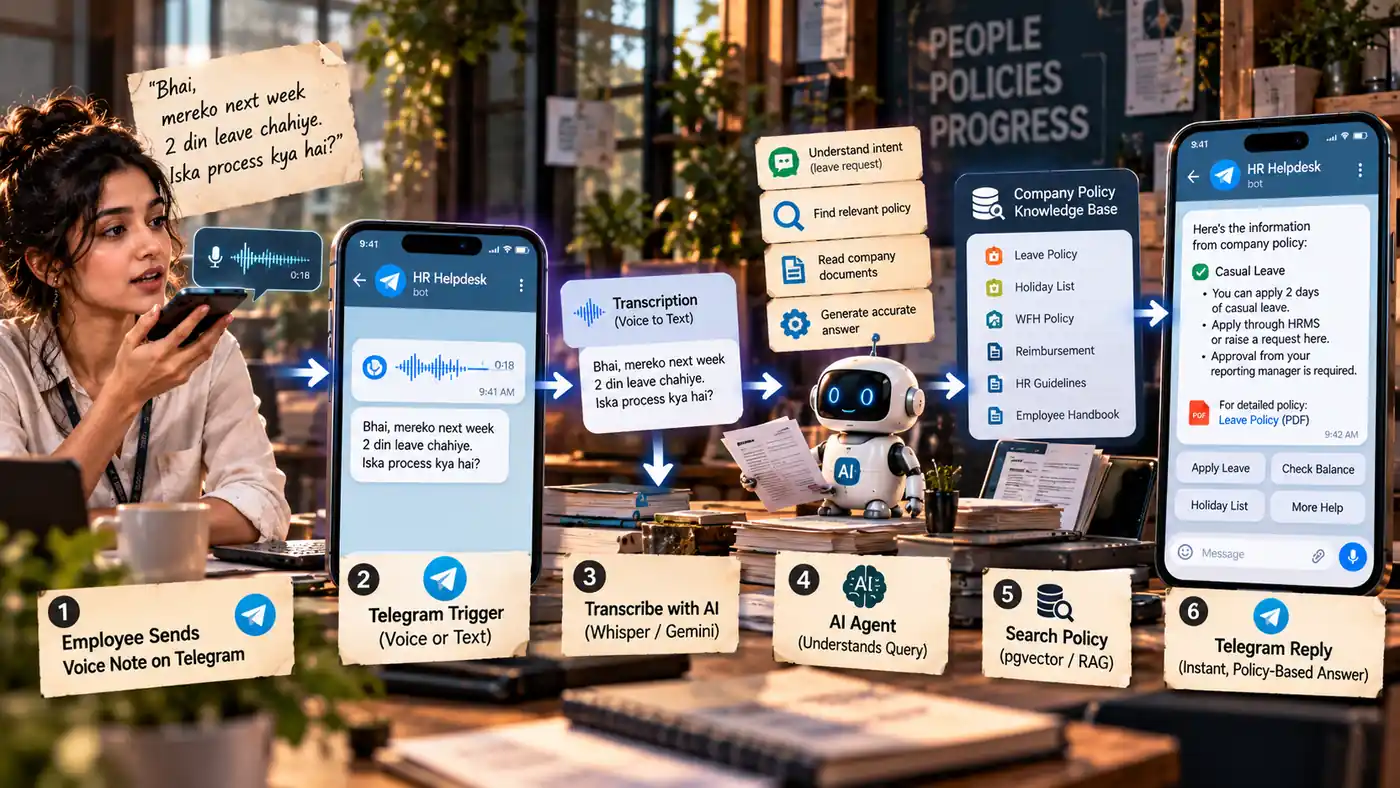
Before building, I ask the owner to list the questions they get most. The answers must already exist in writing somewhere, because the bot only repeats what your documents say. This is a typical question bank for an HR chatbot for employees in a small Indian company.
| Staff asks | Answered from | Bot can answer? |
|---|---|---|
| How many casual or sick leaves do I get in a year? | Leave policy PDF | Yes, the rule itself |
| How many leaves do I have left? | Your attendance or HR software | Only if connected; otherwise it says who to ask |
| When is salary credited? | Payroll policy | Yes |
| Is Diwali a holiday? What is the holiday list? | Holiday calendar PDF | Yes |
| How do I claim travel expenses? | Reimbursement policy | Yes, with the steps |
| What is the notice period? | HR policy or offer letter template | Yes, the general rule |
| My laptop is not charging. What do I do? | IT support guide | Yes, first steps and who to contact |
| What is the office Wi-Fi password? | IT guide | Only if you choose to include it |
| Can I get a salary advance? | Advance policy, if you have one | Yes, or it routes to the owner |
Notice the difference between a rule and a personal record. The HR helpdesk chatbot on Telegram answers rules from policy PDFs out of the box. Personal numbers, like your leave balance, need a link to the system that holds them, which I treat as a separate second step with its own privacy checks.
A good test before building: if a new joiner could find the answer by reading your documents carefully, the bot can find it too. If the answer only lives in the founder’s head, the first job is to write it down. That writing exercise alone often clears up confusion inside the team, even before any HR chatbot for employees goes live.
From voice note to answer: the node path
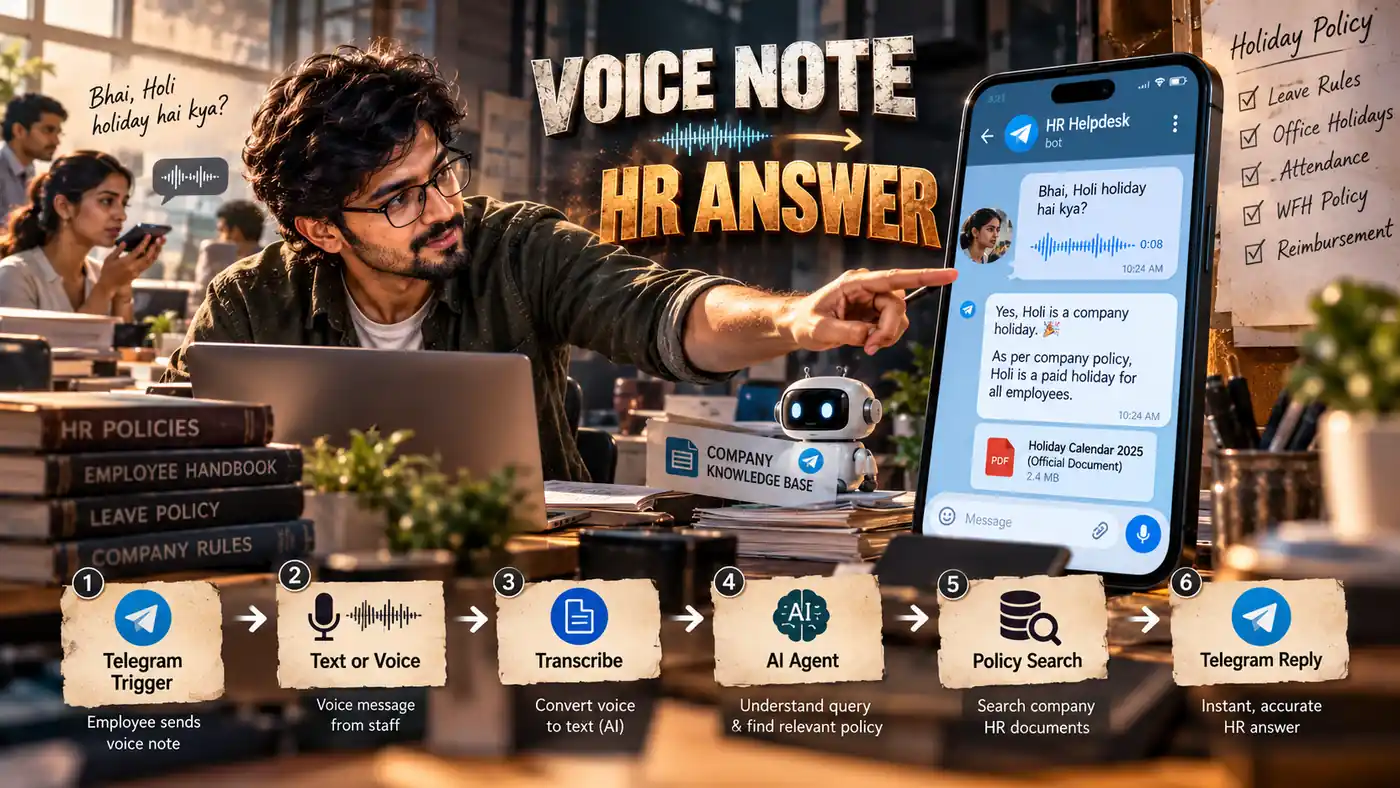
There are six main nodes. A Telegram “get file” step sits inside the voice branch to download the recording, but the logic stays a simple line with one fork at the start.
| # | Node | Job | Next | If it breaks |
|---|---|---|---|---|
| 1 | Telegram Trigger | Receives each staff message, text or voice | Switch | Messages arrive but nobody answers |
| 2 | Switch: text or voice? | Checks if the message has a voice file | Transcription or AI Agent | Voice notes are ignored |
| 3 | OpenAI audio transcription | Converts the downloaded voice note into text | AI Agent | Voice questions fail; text still works |
| 4 | AI Agent (LangChain) | Reads the question and decides what to search | Postgres vector store | Answers become generic, not from your policy |
| 5 | Postgres pgvector plus embeddings | Finds the closest policy paragraphs | Back to the AI Agent | Bot guesses leave rules |
| 6 | Telegram: send message | Sends the answer to the same employee | End | Answer is ready, but never delivered |
The audio transcription step only runs for voice notes. Text messages skip it and go straight to the agent. Both paths meet at the same AI Agent, which is why the knowledge base and the rules only have to be maintained in one place.
I also give the agent a short memory keyed to each employee’s chat, so a follow-up like “and for sick leave?” makes sense without repeating the whole question.
Here is how one real-style question travels. A store supervisor holds the mic and says in Hindi, “Kal Holi hai, kya office band rahega?” The trigger receives a voice message. The Switch sees the voice file and sends it down the voice branch, where the file is downloaded and transcribed into text. The AI Agent reads the text, searches the knowledge base for the holiday calendar, finds the line listing Holi, and writes a short reply: “Yes, Holi is a paid holiday this year as per the 2026 holiday list.” Telegram sends that reply to the supervisor within seconds. No one in management had to pick up the phone.
The same path handles a typed question in English with one step fewer. That consistency is what makes an HR helpdesk chatbot on Telegram easy to trust: every answer comes from the same place, whichever way the question was asked.
Building the pgvector knowledge base from policy PDFs
The pgvector knowledge base is a normal Postgres database with the pgvector extension switched on. Each policy PDF is cut into small chunks, each chunk is turned into an embedding, and the embeddings are stored so the bot can find the paragraph closest in meaning to a question.
- Create a Postgres database. Supabase, Neon or your own server all work.
- Enable the extension with the command below.
- Build a small separate workflow: read the policy PDF, extract the text, split it into chunks of a few hundred words, create embeddings and insert them with the Postgres PGVector Vector Store node.
- Run it once per policy PDF, and again whenever a policy changes.
-- run once in your Postgres database
CREATE EXTENSION IF NOT EXISTS vector;
n8n creates the table it needs on first insert. I keep one collection per company, with the PDF name saved on each chunk, so the bot can say which policy an answer came from.
Chunk size matters. Chunks that are too long mix several rules together and confuse the search. Chunks that are too short lose the context, such as which kind of leave a number belongs to. A few hundred words with a small overlap between chunks works well for typical Indian HR policies.
Why audio transcription comes before the agent
Some people ask why I do not send the voice note straight to an AI model that understands audio. The reason is control. When audio transcription happens first, the rest of the workflow only ever deals with text. The same agent, the same prompt and the same pgvector search work for every question, whichever way it arrived.
Text is also easy to check. If an employee complains that the bot gave a wrong answer, I can see the transcribed question in the n8n execution log and know immediately whether the problem was the audio or the policy search. With audio going straight into a model, that debugging becomes guesswork.
Finally, transcription quality varies by language and background noise. By keeping it as its own step, I can swap the transcription model later without touching the agent. Hindi and English transcribe well. Regional languages like Telugu and Tamil usually work, but noisy voice notes from a shop floor may need the bot to reply with “I heard this, is that right?” before answering.
This is also why voice note support costs very little extra to run. Transcribing a short voice note is a small request, and the answer is produced by the same agent that handles text. You are not paying for two separate bots.
When a node fails: silent bot, wrong policy, bad audio
These are the failures that come up most with an HR bot or an IT support bot, and how I fix each one.
| Problem | Why it happens | What to do |
|---|---|---|
| Bot never replies | Workflow not active, or webhook not registered | Activate the workflow and send the bot /start again |
| Bot silent in the staff group | Telegram privacy mode stops bots reading all group messages | Mention the bot in the group, or change privacy mode through BotFather |
| Voice note gives an error | File not downloaded before transcription | Add or fix the Telegram “get file” step in the voice branch |
| Transcript is nonsense | Heavy background noise or a very short clip | Ask staff to record closer to the phone; bot confirms what it heard |
| Answer is correct but from an old policy | Old PDF chunks still in the database | Delete the old document’s chunks before loading the new version |
| Bot invents a rule | Search found nothing and the agent filled the gap | Tell the agent to reply “I could not find this in the policy” instead |
| Anyone on Telegram can use the bot | No access check | Allow only a list of staff Telegram IDs |
The last row matters more than it looks. A Telegram bot is public by default, so an access list is the first thing I add, before any policy is loaded.
When the HR helpdesk chatbot on Telegram stops answering, check the n8n executions list first. A red execution shows exactly which node failed and why. Most issues are an expired key or a policy file that was replaced without reloading the knowledge base.
Step-by-step setup
- Collect every policy PDF: leave, payroll, holidays, reimbursements, IT guide. Make sure each one is the current version.
- Create a Telegram bot through BotFather and note the token.
- Get an OpenAI API key for transcription, the chat model and embeddings.
- Set up Postgres with pgvector and add its credentials in the workflow platform.
- Build the loader workflow and load each policy PDF into the knowledge base.
- Build the chat workflow: Telegram Trigger, Switch, get file plus transcription, AI Agent with the vector store tool and memory, Telegram reply.
- Add the staff ID check right after the trigger.
- Write the agent’s instructions: answer only from the policy, name the source, stay short, and give the owner’s contact when unsure.
- Test with 20 real questions, typed and spoken, before announcing it to staff.
Keep the Telegram token and OpenAI key inside the platform’s credential store. Never paste them into a policy PDF or a shared sheet.
For hosting, a cloud-hosted setup is the easiest start. If you want the data to stay on a server you control, self-hosting with Postgres on the same machine works well and keeps policy text inside your own setup. Either way, check current pricing for the platform and OpenAI on their websites, as it changes often.
Writing policy pages the bot can read
A bot is only as clear as the documents behind it. Most small companies have policies written as long paragraphs copied from somewhere else. A little cleanup makes a big difference to how well the pgvector knowledge base finds the right answer.
| Do | Don’t |
|---|---|
| One topic per heading: “Casual leave”, “Sick leave” | One long paragraph covering five kinds of leave |
| Write numbers plainly: “12 casual leaves per calendar year” | “As per company norms” |
| Use text-based PDFs or Word files | Scanned photos of printed pages |
| Put the date and version on each policy | Keep three versions with the same file name |
| Name the person to contact for exceptions | Leave exceptions unexplained |
IT support bot jobs vs human-only jobs
The same setup doubles as an IT support bot. Still, some things should never be handed to a bot. This is how I split the work.
- Good jobs for the bot: Wi-Fi and printer steps, how to reset an email password through the self-service page, VPN setup guide, which software is allowed, how to raise a hardware request.
- Human-only jobs: salary disputes, harassment complaints, resignations, medical leave with personal details, disciplinary matters, anything involving another employee’s data.
For the human-only list, the bot does one thing: it tells the employee, kindly, who to talk to and how. I would rather it hand over too early than try to handle a sensitive complaint.
One more rule I follow: the bot never pretends to be a person. Its first message says it is an automated assistant that answers from company policy, and it shares the owner’s or manager’s contact for anything it cannot answer.
How my team delivers the HR helpdesk chatbot on Telegram
When you hire my team for this, most of the effort goes into your documents, not the nodes. Timelines depend on how many policies you have and how ready they are, and I confirm them after a first look.
The chatbot in this article is one working example. For your business, my team can build the same HR helpdesk on whichever automation platform you already use or prefer, or on a custom setup around your own systems.
| Stage | My team’s work | Your part |
|---|---|---|
| Policy review | Reads your policies, marks gaps and contradictions | Send all current policy PDFs |
| Cleanup | Suggests edits so each rule is clear and findable | Approve or correct the edits |
| Build and load | Sets up the bot, database and workflows; loads the policies | Share the list of staff Telegram IDs |
| Staff test | Runs the HR helpdesk chatbot on Telegram with three or four staff first | Pick testers who will ask real questions |
| Launch | Announces the bot with a short how-to message | Tell your team it is official |
| Handover | Shows you how to add or replace a policy PDF | One short call |
After launch, the owner’s job shrinks to updating a policy when it changes. The bot handles the repeat questions.
When your policies change, for example a new leave rule from April, you replace the PDF and run the loader again. The HR helpdesk chatbot on Telegram starts answering from the new rule in minutes, and the old version stops appearing because its chunks are removed first.
Versions I build for clinics, retail chains and coaching centres
The core stays the same across sectors, but the questions and the documents change. These are the variations of the HR chatbot for employees that suit Indian businesses best.
| Business | Typical staff | What the bot covers | Extra care |
|---|---|---|---|
| Clinics and diagnostic labs | Nurses, front desk, technicians on shifts | Shift swap rules, uniform policy, sample handling SOPs | Keep all patient data out of the knowledge base |
| Retail chains | Store staff across cities | Store opening checklist, returns policy, incentive rules | Voice notes in local languages are common |
| Coaching centres | Faculty and counsellors | Class schedule rules, leave in exam season, fee refund policy | Separate staff policies from student-facing ones |
| Small factories | Supervisors and workers | Safety rules, overtime policy, PF and ESI basics | Short voice answers work better than long text |
In each case, voice note support matters most for staff who spend their day on their feet. An HR chatbot for employees that only accepts typed English would simply not be used on a shop floor or in a clinic corridor.
Want this for your staff? Email me
Tell me roughly how many people work with you and which questions eat most of your time. I will tell you honestly whether a bot helps or whether a simple pinned FAQ would do. Keep these ready for the first call:
- Your team size and the languages your staff speak
- The policy documents you already have, even rough ones
- Whether you want voice note support from day one
My email is contact@upcomingtools.com. Send your phone number in the email and I will call you. You can also leave a message on the contact page, or first learn more about me and my team. Because this bot handles employee questions, please go through the privacy policy; I design every build keeping India’s Digital Personal Data Protection Act, 2023 in mind and keep personal records out of the knowledge base. Paid work is covered by the refund policy.
