

About Us
The argument in favor of using filler text goes something like this: If you use real content in the Consulting Process, anytime you reach a review point you’ll end up reviewing and negotiating the content itself and not the design.
Automation for small Indian businesses: what I set up for shop owners who never asked for tech
Automation for small Indian businesses: what I set up for shop owners who never asked for tech
Last week an email reached my team from a man who runs a fertiliser and seeds shop in a small town in West Godavari. The email was three lines long. In it he wrote that his son keeps telling him to “go digital”, that he has no idea what that means for a shop like his, and that he only wanted to know one thing: is automation only for big companies?
My brother on the team forwarded it to me with a single word: “Yours.” He was right. That question lands in our inbox more often than any other, in different words, from kirana owners, tailors, tuition teachers, small clinics and hardware shops. I answered the man that evening, and this is the longer version of the reply, written for every owner who has wondered the same thing and never asked.
The short answer is no. At the scale of one shop and one owner, automation for small Indian businesses means handing a few boring, repeated jobs to a tool on your phone so you get your evenings back. Everything below is about which jobs, which tools, what it costs you in effort, and where it goes wrong.
What I cover in this reply
What that email was really asking

When a shop owner asks whether automation is only for big companies, he is usually asking three smaller questions at once. Will it cost too much? Will I understand it? Will it break my business if something goes wrong?
I take those questions seriously, because I grew up around shops like his. In Palakollu, where I come from, most businesses on the main road still close their books by hand at night. The owners are sharp. They know every regular customer, every supplier and every rupee that moves through the counter. What they lack is time, because the same hand that serves customers all day also writes every bill, remembers every reminder and counts every shelf.
So my answer to the first question is that the useful tools at this scale are cheap or free to start. My answer to the second is that anyone who can use WhatsApp can use most of them, provided someone sets them up properly the first time. And my answer to the third is the most important: you never switch everything at once. You change one job, run the old way and the new way side by side for a while, and only drop the notebook when you trust the new system.
That approach sits under all the business automation ideas for small shops my team works on, and of all the free help we give to owners who cannot pay.
Automation for small Indian businesses, seen from one counter
Picture the counter of a small shop at seven in the evening. A customer wants a bill. Another asks on the phone whether a product is back in stock. A regular customer’s credit has to be noted somewhere. The owner remembers, halfway through a sale, that he promised to remind someone about an order. Later, after closing, he sits with the register and adds up the day.
Every one of those moments is a small job. None of them is difficult. Together they eat hours that the owner never counts, because they are spread across the day in two-minute pieces.
Automation at this level means picking the jobs that repeat in exactly the same way every day, and letting a tool do them. A bill gets generated by a billing app instead of being written by hand. A stock number drops by itself when an item is sold. A reminder message goes out on its own when it is due. A common question, such as shop timings or whether home delivery is available, gets a ready answer without the owner typing it again.
This is also what digitizing a small business in India looks like in practice for most of the owners who write to us. It is a slow, careful shift in how a few jobs get done, owned by the same person who runs the shop, at a pace he controls. The business stays the same business. The owner simply stops doing by hand what a phone can do for him.
There is a reason this has become possible for the small shop and not only the large company. Digital payments have spread across the country at a remarkable pace. The Reserve Bank publishes a Digital Payments Index to track this, and its press release of 12 February 2026 put the index at 516.76 for September 2025, against a base of 100 in March 2018. That is a national figure, and it doesn’t measure any one town. What I see on the ground matches its direction: customers in small towns now pay by phone as a matter of habit, and once money is digital, a lot of the paperwork around it can be too.
Four jobs that quietly eat an owner’s evening
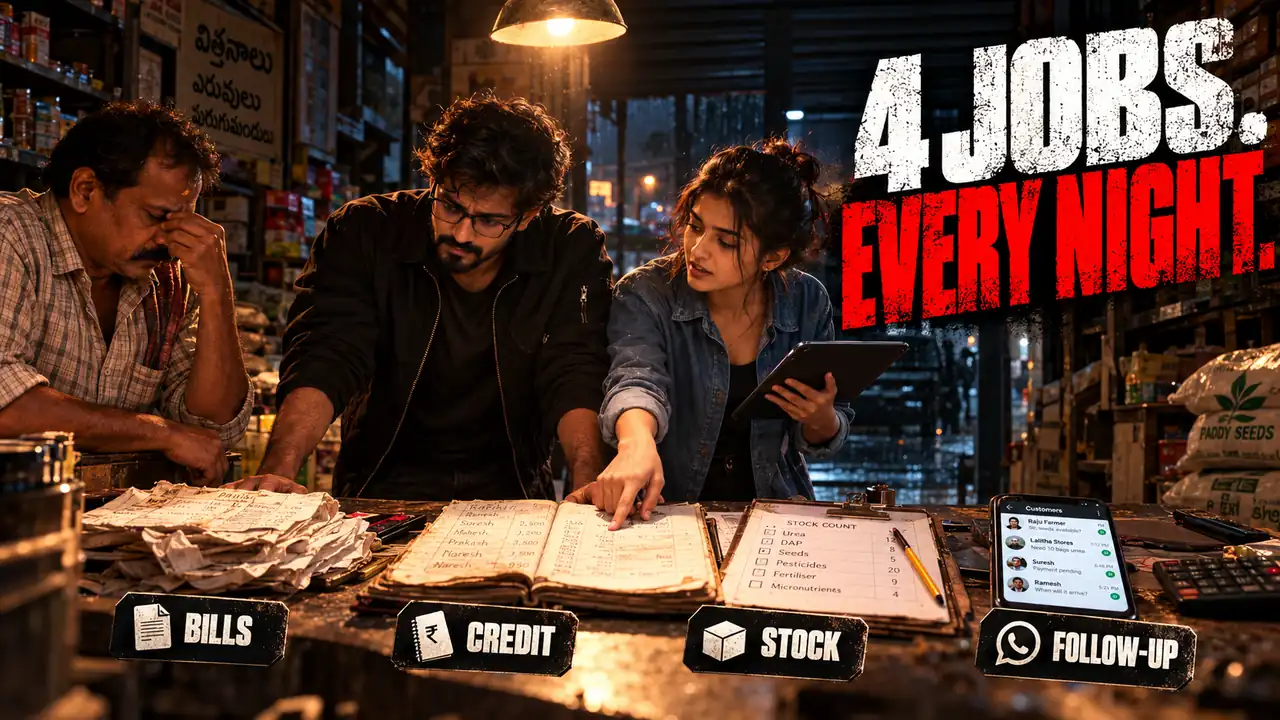
When my team sits with a new shop owner, we ask him to describe one ordinary day from opening to closing. Almost every time, the same few jobs come up as the ones he resents most.
Writing bills and working out tax
A hand-written bill takes time, and a hand-calculated tax figure invites mistakes. For a shop registered under GST, a wrong rate or a missing invoice number can turn into a correction job weeks later, when the return is being prepared. A billing app built for Indian retail generates the invoice, applies the tax rate you set for each item, and keeps a record you can pull up at the end of the month. If your business has crossed the point where GST registration is required, the GST portal is where registration and returns happen, and a billing app that keeps clean records makes that work far lighter.
Following up with customers
A salon that doesn’t remind a client when it has been a while since her last visit, a shop that forgets to tell a regular customer that his usual item is back, a tutor who never follows up with a parent who enquired: each of these is money left on the table. The owner cares. He simply cannot remember every person by hand once the customer list grows past a few dozen names.
This is where WhatsApp Business earns its place. A properly set up business profile with a product catalogue, a greeting message, an away message for after hours and quick replies for the questions that come up every day handles a large part of this job. Customers already use WhatsApp, so nobody has to learn anything new.
Knowing what is on the shelf
A shop that sells physical goods loses money in two directions when stock is tracked by memory. It reorders things that are still sitting unsold, and it runs out of the things that sell fastest. Both happen because nobody has a current picture of the shelf without counting it. A billing app that is linked to stock solves this quietly: every sale reduces the count, and a short list of low items can be checked before calling the supplier.
The credit book
There is a fourth job I almost always find, and owners rarely list it because it feels personal: the credit book. In a small town, regular customers buy on credit and settle at the end of the month or when their wages or crop money arrive. The owner keeps their balances in a notebook, and chasing those balances is awkward for everyone.
A billing app that records credit sales against each customer’s name, and a polite WhatsApp reminder at the agreed time, removes most of that awkwardness. The owner no longer has to remember who owes what, and the customer gets a clear, friendly note instead of an uncomfortable conversation at the counter. Among the low cost automation ideas for MSMEs, this one often pays back fastest, because money that arrives on time is money the owner doesn’t have to borrow.
These four are where most business ideas helping shops save time begin, because they are the jobs every owner feels and few owners describe as a systems problem. He calls it a bad week, a careless helper or bad luck. Very often it is a notebook doing a job a phone could do better.
Automating a small business without coding: what my team sets up first
None of the fixes above needs a programmer. Automating a small business without coding, at this scale, is mostly about choosing the right ready-made tool and setting it up carefully for that particular shop. My team writes custom workflows for bigger clients, but for a single-counter business the ready-made route is almost always the right first step. I’ve watched owners overspend on custom software when a free app would have done the same job, and I’d rather you keep that money in the business.
Here is the order we usually follow, and what each step asks of the owner.
| The job today | What replaces it | What the owner has to do |
|---|---|---|
| Hand-written bills and tax sums | A billing app with GST rates set per item | Enter the product list once, and learn to raise a bill in the app |
| Customer reminders from memory | WhatsApp Business with catalogue, greeting, away message and quick replies | Approve the message wording, keep the catalogue current |
| Counting shelves to know what to reorder | Stock linked to the billing app, with a low-stock list | Do one honest count at the start, then bill every sale through the app |
| Booking appointments on paper | A simple booking or calendar tool with reminders | Share the booking link with customers, check the calendar each morning |
| Closing the day’s books by hand | The billing app’s daily summary | Check the summary against the cash drawer for the first few weeks |
You will notice the table has no hours-saved column. Every shop is different, and I would rather you measure your own saving than trust a number I made up. Write down how long closing takes you tonight. Write it down again after a month of using the app. That comparison is the only figure that matters for your shop.
Why one job at a time
The owners who try to change everything in one week usually go back to the notebook by the next week. The ones who change one job, live with it for a fortnight and then add the next, are still using the system months later. We set up the job that hurts most first, run it beside the old method until the owner trusts it, and only then move to the next one.
Why the owner stays in charge
Every account we set up is created in the owner’s own name, on his own phone or computer. My team helps, trains and checks in, but the shop’s data belongs to the shop. If an owner ever wants to stop working with us, nothing goes with us when we leave. I think this matters more than any feature.
What it costs
Most small business automation tools for a single shop start with a free tier, and the paid plans that add GST features, more users or reports cost a modest monthly fee. WhatsApp Business itself is free to download. Prices change often and differ by provider, so check the current plan on the provider’s own site before you commit, and start on the smallest plan that does the job. These are the low cost automation ideas for MSMEs I recommend first, because the risk is small and the owner can stop at any time.
Registration, loans and paying for the setup
Owners often treat registration and automation as two separate topics. They connect more closely than people expect.
Udyam registration helps more than the shop owner thinks
Many small retailers assume government MSME schemes are only for manufacturers. That changed some years ago. The Reserve Bank’s FAQ on MSME lending explains that the Ministry of MSME, through an office memorandum dated July 2, 2021, included retail and wholesale trade as MSMEs for the limited purpose of priority sector lending, and allowed them to register on the Udyam Registration Portal. The same FAQ describes the Udyam Assist Platform, which helps informal micro enterprises formalise even if they lack a PAN or GSTIN.
Registration itself is done on the Udyam registration portal, using the Aadhaar number of the proprietor, or of the managing partner for a partnership firm. For many of the owners who come to us through our free help, this registration is the first thing we sit with them on, before any tool is set up, because it makes the later conversation with a bank much easier.
Paying for a counter tablet or a printer
The monthly cost of the software is small, but a shop may want a tablet for the counter, a small receipt printer or a barcode scanner. That is real money upfront. A shop owner who would rather borrow than drain his working capital can look at the MUDRA scheme, which offers loans to non-corporate, non-farm small and micro enterprises through banks, regional rural banks, small finance banks, MFIs and NBFCs. Ask your bank which category fits your amount and stage.
Formal credit for small enterprises also gets support from CGTMSE, which provides guarantee cover for collateral-free credit that eligible lenders extend to micro and small enterprises. Whether your particular loan qualifies is a question for your bank, and it is worth asking before you assume you need to offer security.
Where automation for small Indian businesses goes wrong
I want to be honest about the failures, because I have cleaned up after a few of them, and every one was avoidable.
The tool was built for someone bigger
The most common failure is a heavy system meant for a mid-sized company, installed in a single-owner shop that needed something simple. The owner opens it, sees forty menus, and quietly goes back to his notebook. More features make the system harder to adopt. For a small shop, the simplest tool that does the job is the best tool.
Nobody trained the owner
Some tools are easy to pick up. Many are easy only for someone who has used similar apps before. When an owner or a helper gets stuck in the first week and nobody shows them what to do, the conclusion is always “this technology doesn’t work for us”. In most cases the real gap was one patient hour of training at the start.
The wrong job got automated
A beautifully automated billing system cannot fix a shop whose real problem is that too few customers walk in. Automation saves time on jobs that already exist. If the business needs more customers, the first work is on reaching them, and automation can come after.
The setup was copied from another shop
What works at a retail counter often fits a salon or a tuition centre badly, because their busiest moments and biggest headaches are different. My team spends the first conversation with any owner only on listening to how his day runs. The tools come later.
If you want to do this work for other shops

Some readers of this blog are students or young people looking for a side income, and if that is you, there is a real opportunity here. The gap between “these tools exist” and “this shop owner has them set up and uses them every day” is wide, and filling it, one shop at a time, is a service people will pay for.
Automation services business ideas at this level follow a simple shape. Visit the shop. Listen to how the owner’s day runs. Set up the two or three tools that solve his biggest headaches. Train him and his helpers patiently. Then stay available in the first few weeks, when real questions come up during real rush hours.
Business ideas around automating local shops succeed or fail on that last part. An owner who gets a lovely setup and is then left alone the first time something goes wrong will go back to paper, and in a small town, word of a bad experience travels fast. The people who build a lasting service treat the first month after setup as the real test, and they check in before the owner has to call.
On pricing, a setup fee for the configuration and training, plus a small monthly fee for ongoing support, tends to suit both sides better than one large payment. It matches how the value arrives over time, and it keeps the service provider invested in the system working.
Among automation business ideas in India, this one has a low entry cost and a steady supply of customers, because almost every town has more shops than it has patient people willing to sit with them. If you try it, start with one shop you know well, do it properly, and let that owner tell the next one.
What to learn before your first shop
You don’t need to be a programmer, but you do need to know the tools better than the owner does. Before you knock on a single shop door, set up a billing app and a WhatsApp Business profile for an imaginary shop of your own. Raise fake bills, add products, mark stock as sold, send yourself reminders and see what the customer sees. Break things on purpose and learn how to fix them.
Learn the basics of GST invoices and Udyam registration too, at least well enough to explain them in plain words and to know when to send the owner to a CA. Shop owners trust the person who can answer their small questions without making them feel foolish.
Then pick a small set of small business automation tools and get very good at them. A provider who knows three tools deeply will serve shop owners better than one who has tried thirty. The strongest automation services business ideas I’ve seen were built by people who stayed patient, kept their promises and treated every owner’s shop as if it were their own family’s.
Business ideas around automating local shops also grow naturally from one service into the next. An owner who trusts you with his billing will ask you about his catalogue, his Udyam registration, his first loan application. Each of those is a chance to help, and a reason to keep your word every single time.
Questions shop owners send me
Is automation only for big companies?
No. For a small shop, automation means letting a phone app handle a few jobs that repeat every day, like writing bills, tracking stock and sending reminders. Most of the tools my team sets up for small owners start free or cost a modest monthly fee, and they run on the phone the owner already has.
Do I need a computer, or is my phone enough?
For most single-counter shops, a phone is enough to start. Billing apps, WhatsApp Business and simple booking tools all run on a smartphone. Some owners later add a tablet or a small receipt printer at the counter, but that can wait until the basic setup is working and trusted.
Can a retail shop register on Udyam?
Yes. The Reserve Bank’s MSME lending FAQ explains that retail and wholesale trade were included as MSMEs for the limited purpose of priority sector lending in July 2021, and allowed to register on the Udyam Registration Portal. Registration uses the Aadhaar number of the proprietor, or of the managing partner for a partnership firm.
What if the app stops working on a busy day?
That is exactly why my team runs the old method and the new one side by side for the first couple of weeks. Keep your notebook handy until you trust the app completely. Once it has worked through a few busy days, the risk becomes small, and your records are safer in the app than on paper.
Which automation business ideas in India suit a student with no coding skills?
Setting up billing apps, WhatsApp Business catalogues and reminders for local shops is a strong start. These are business ideas helping shops save time, and they need patience, clear explanations and good knowledge of a few tools more than programming. Start with one shop you know well and do it properly.
Before you change anything, write down one evening
Here is the one thing I asked the fertiliser shop owner to do before anything else, and I’ll ask you the same. Tonight, after you close, note down each job you do and roughly how long it takes: the bills, the credit book, the stock check, the messages you meant to send. Don’t change anything yet. Just write it down.
That single page tells you which of the business automation ideas for small shops above is worth starting with, and it gives you a number to compare against a month from now. When the owner sent his page back to us, the answer was obvious: his stock check was taking most of his evening, so that is where we began.
If you are just starting out and genuinely cannot pay for setup, my team’s free help for small business owners exists for exactly that, and I decide those requests myself. If your business is already running and you want my team to map and build something specific for you, tell us about it through the contact page or write to contact@upcomingtools.com. Send your phone number in the email if you would rather talk, and one of us will call you back.
Digitizing a small business in India starts with one honest look at where your evening goes, well before any app gets installed.

1 Comment
[…] closed hours. If you want to see how the same thinking extends beyond chats, I wrote earlier about automation for small Indian businesses without writing a single line of […]