
About Us
The argument in favor of using filler text goes something like this: If you use real content in the Consulting Process, anytime you reach a review point you’ll end up reviewing and negotiating the content itself and not the design.
An AI shop assistant in the owner’s own voice, for shops where staff can’t explain products, forget regular customers and wait for the same instructions every morning
An AI shop assistant in the owner’s own voice, for shops where staff can’t explain products, forget regular customers and wait for the same instructions every morning
AI Shop Assistant That Trains Staff in the Owner’s Voice
In most shops, only one person can explain every product properly: the owner. New staff cannot. Regular customers get treated like strangers whenever the owner is away, and the same questions about prices, returns and warranty get three different answers in one day. Meanwhile the owner repeats the same explanations from morning to night and never gets time for anything else.
An AI shop assistant takes the owner’s own answers, written or recorded once, and makes them available at the counter all day. Staff ask a question quietly and hear the owner’s answer back, so training happens during real sales instead of only when the owner has time. This guide explains what the assistant is made of, how to build its knowledge, the rule for handing questions to a person, and the workflow my team uses. It is part of our guide to automation in retail.
What the AI shop assistant is made of
| Part | What it does |
|---|---|
| Counter device | A small speaker and microphone at the counter; a screen is optional |
| Staff earpiece | Lets staff ask quietly and hear the answer during a sale |
| Knowledge Base | Products, prices, offers, rules and the owner’s answers, one row per question |
| Customer Memory | Regulars’ codes, usual purchases, notes and preferred language |
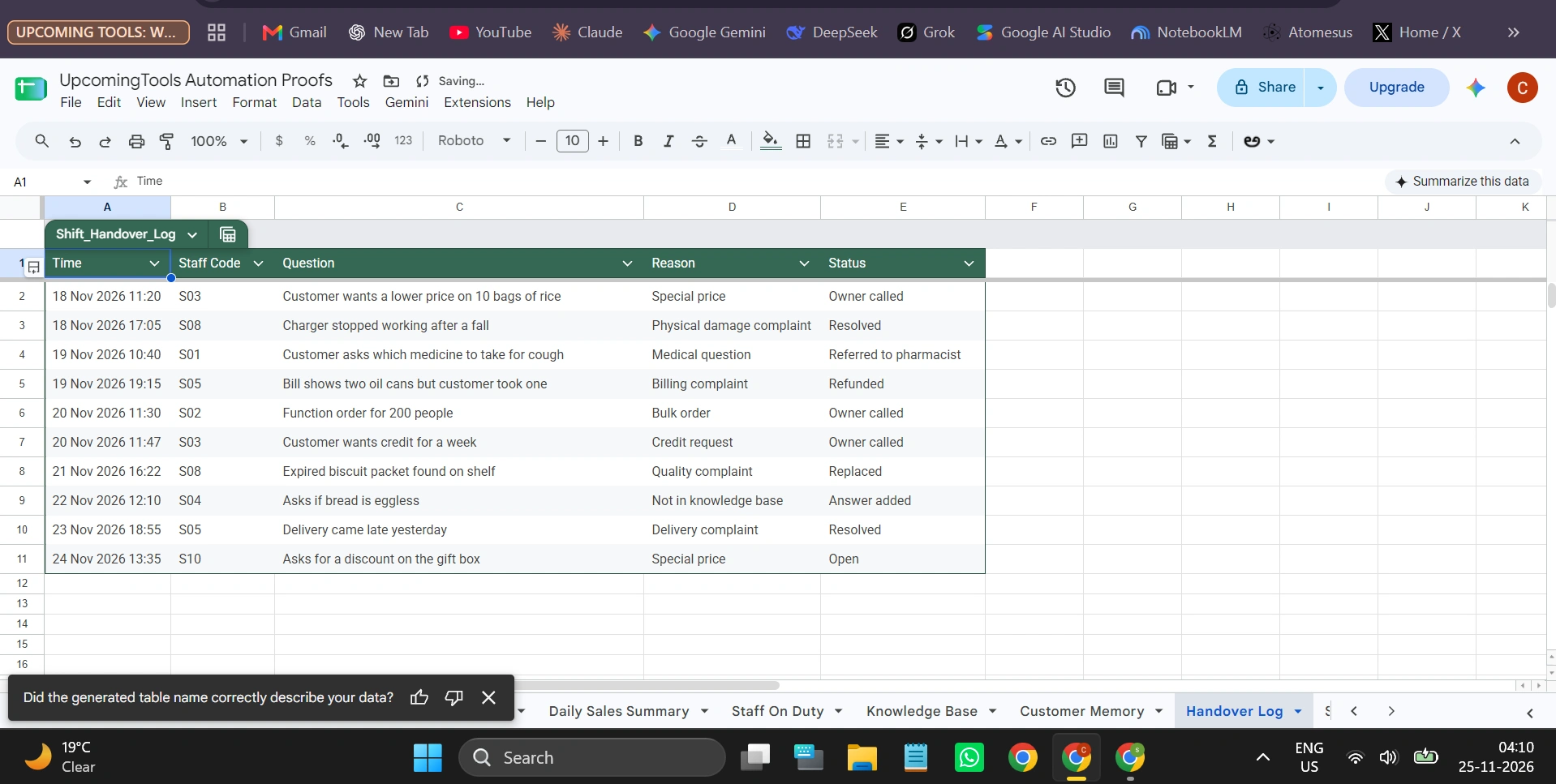
| Handover Log | Every question the assistant passed to senior staff, with the reason |
| Owner’s voice | Built from the owner’s own recordings, with clear consent |
Behind the device sits an AI agent. It is not allowed to make anything up: it answers only from the owner’s rows in the Knowledge Base and the notes in Customer Memory.
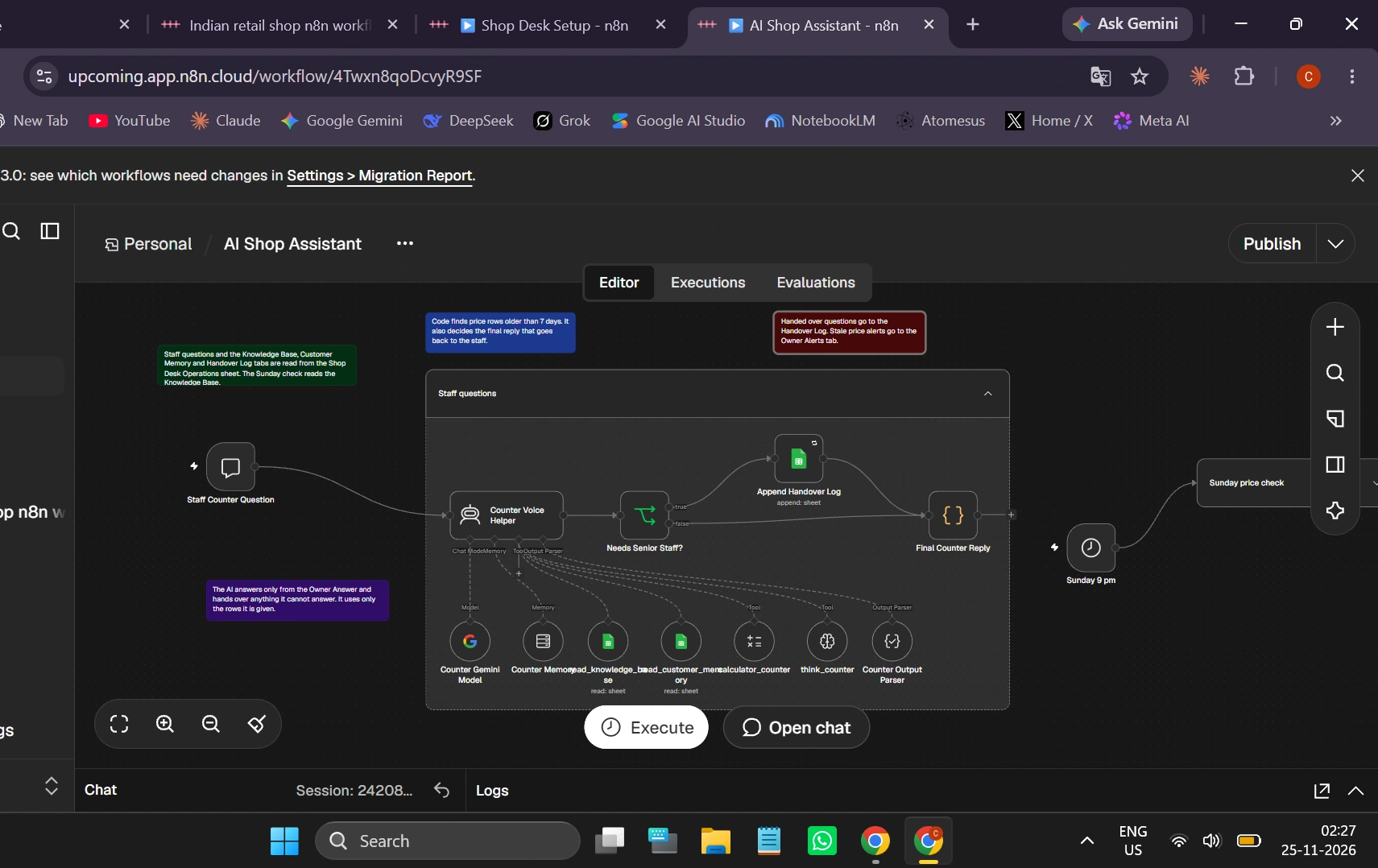
How a counter question is answered
- Staff Counter Question. A staff member asks through the earpiece or the counter screen. The staff code and, if known, the customer code come with the question.
- Counter Voice Helper. A Gemini AI agent looks up the answer. It has memory for each staff member’s session, so a follow-up question makes sense, plus two read-only tools: one for the Knowledge Base and one for Customer Memory.
- The answer. It replies in under 40 words, in the customer’s preferred language when the shop knows it, using only the owner’s own answer.
- Needs Senior Staff? If the question is a complaint, a special price, credit, a bulk order, anything medical, or simply not in the Knowledge Base, the assistant says “Please call the senior staff” and logs the question in the Handover Log.
- Final Counter Reply. The reply goes back to the staff member.
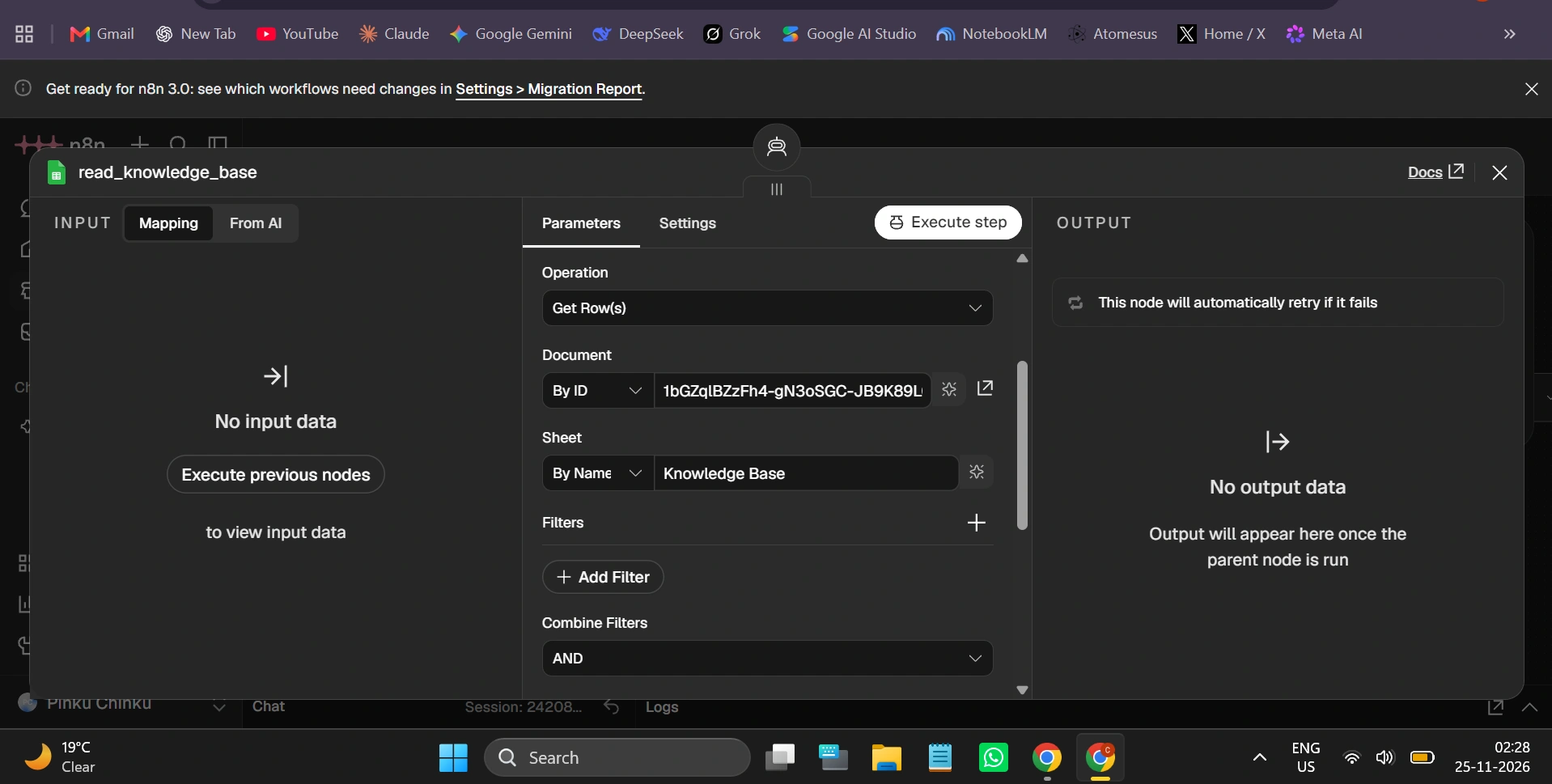
The tool above is the reason the assistant can be trusted: it reads only the Knowledge Base tab of the shop’s own sheet, so every answer traces back to something the owner wrote. The Gemini API documentation explains the model used, and the n8n documentation covers the chat trigger, AI Agent and Google Sheets tools.
Proof of our work on real dashboards
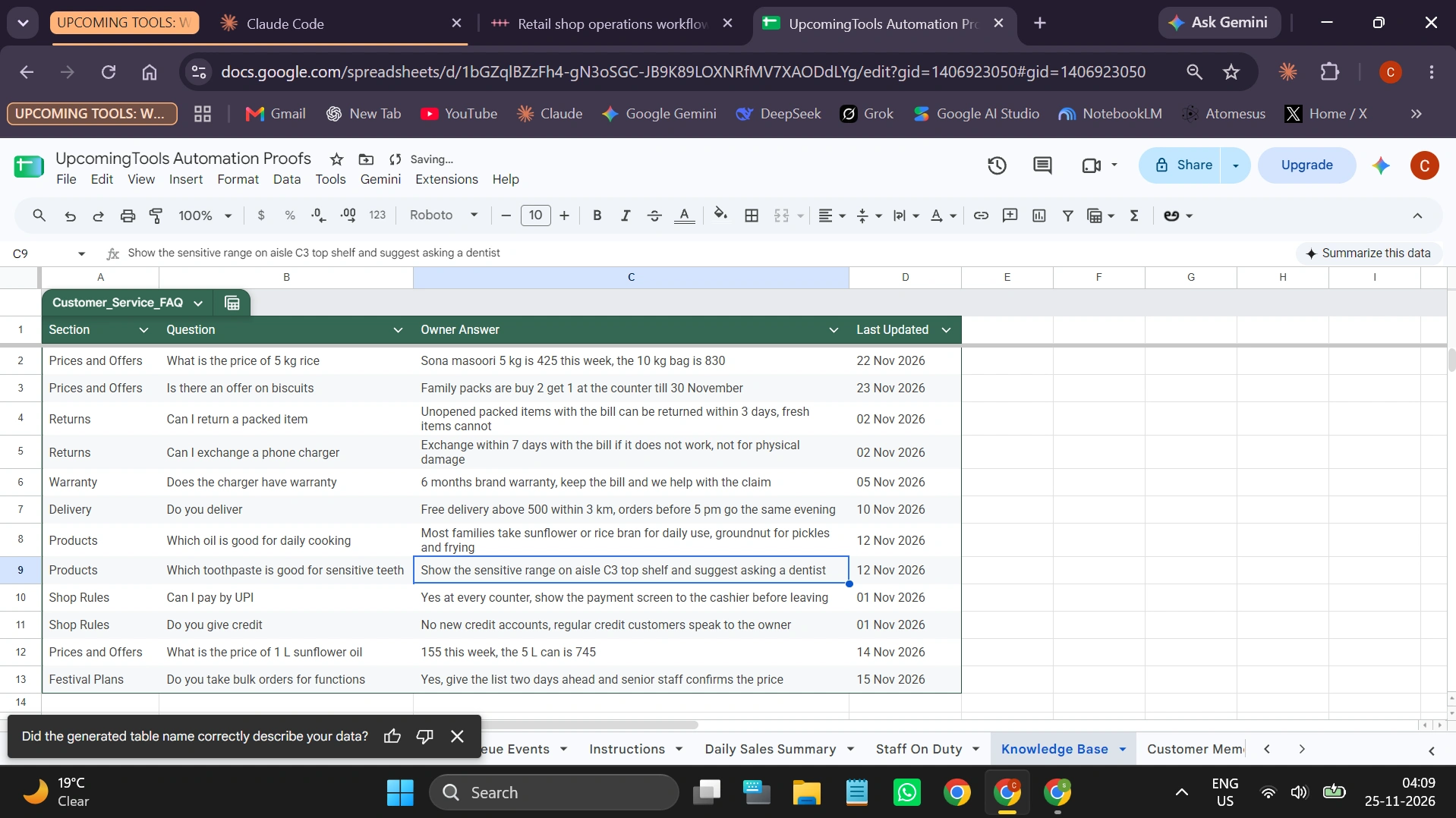
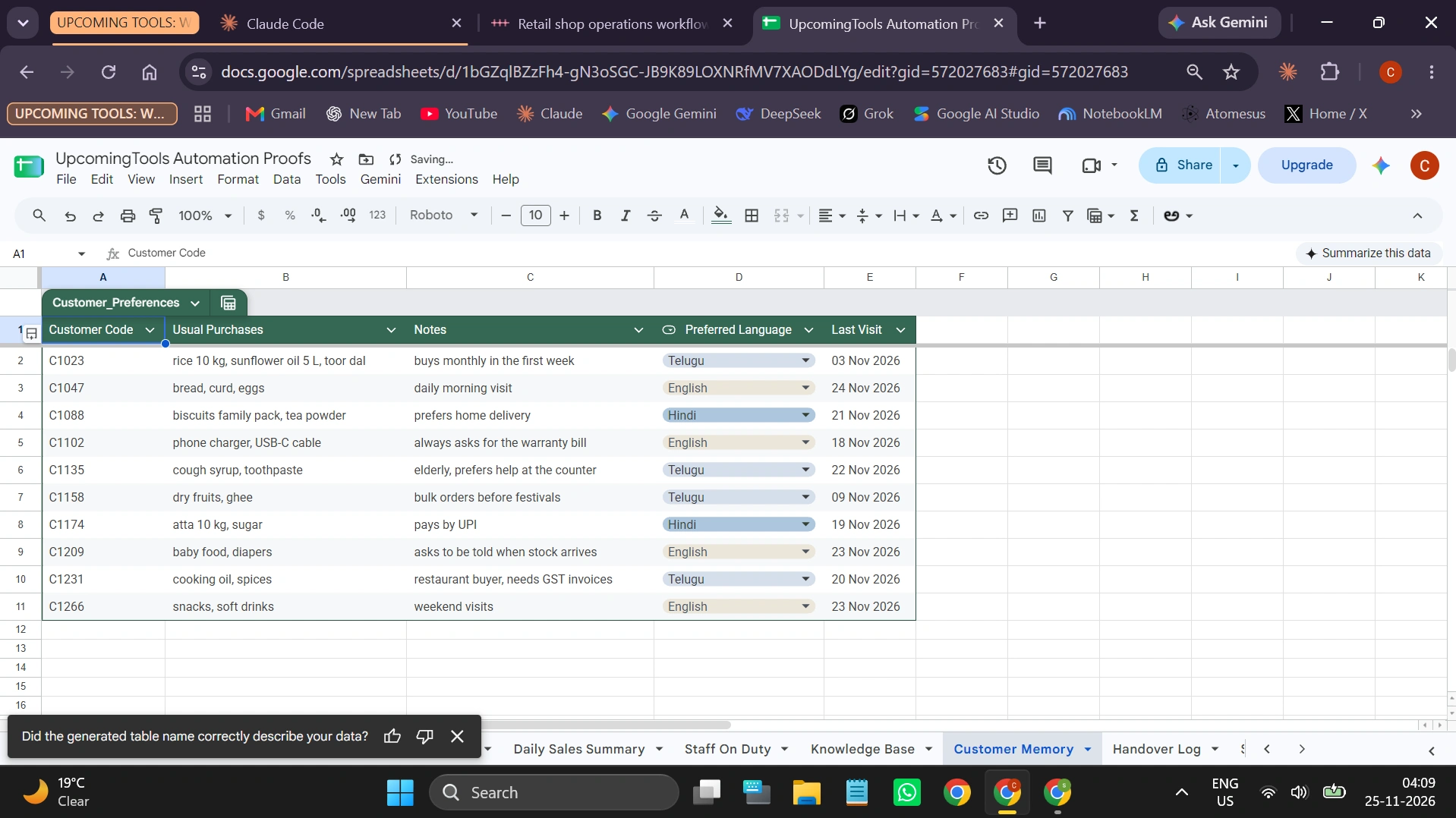
Below are the three sheets the AI shop assistant works from: the owner’s knowledge base, the customer memory and the handover log. This is the real workflow we built, run with sample data, and every answer it gives traces back to one of these rows. The full set is open to anyone in our public automation proofs sheet.
We share this because trust is earned by showing, not by promising. If you are starting with zero investment, live in a rural area or are going through a hard financial time, send one email to contact@upcomingtools.com or drop a comment, and we will set the assistant up for you free. For enterprise-level or custom builds, see custom services.
Building the question bank one evening at a time
The Knowledge Base starts small: the twenty or so questions customers ask most often, answered in the owner’s own words. In most shops, three evenings are enough to cover the most-asked products. Organise it in plain sections that family members can edit without help:
- Products, with the owner’s explanation of each
- Prices and current offers
- Returns, warranty and delivery
- Shop rules, such as credit and payment
- Festival plans and bulk orders
Keep every answer as short as the owner would say it at the counter. Long answers slow the reply down, and staff stop using it within days.
Keeping prices fresh
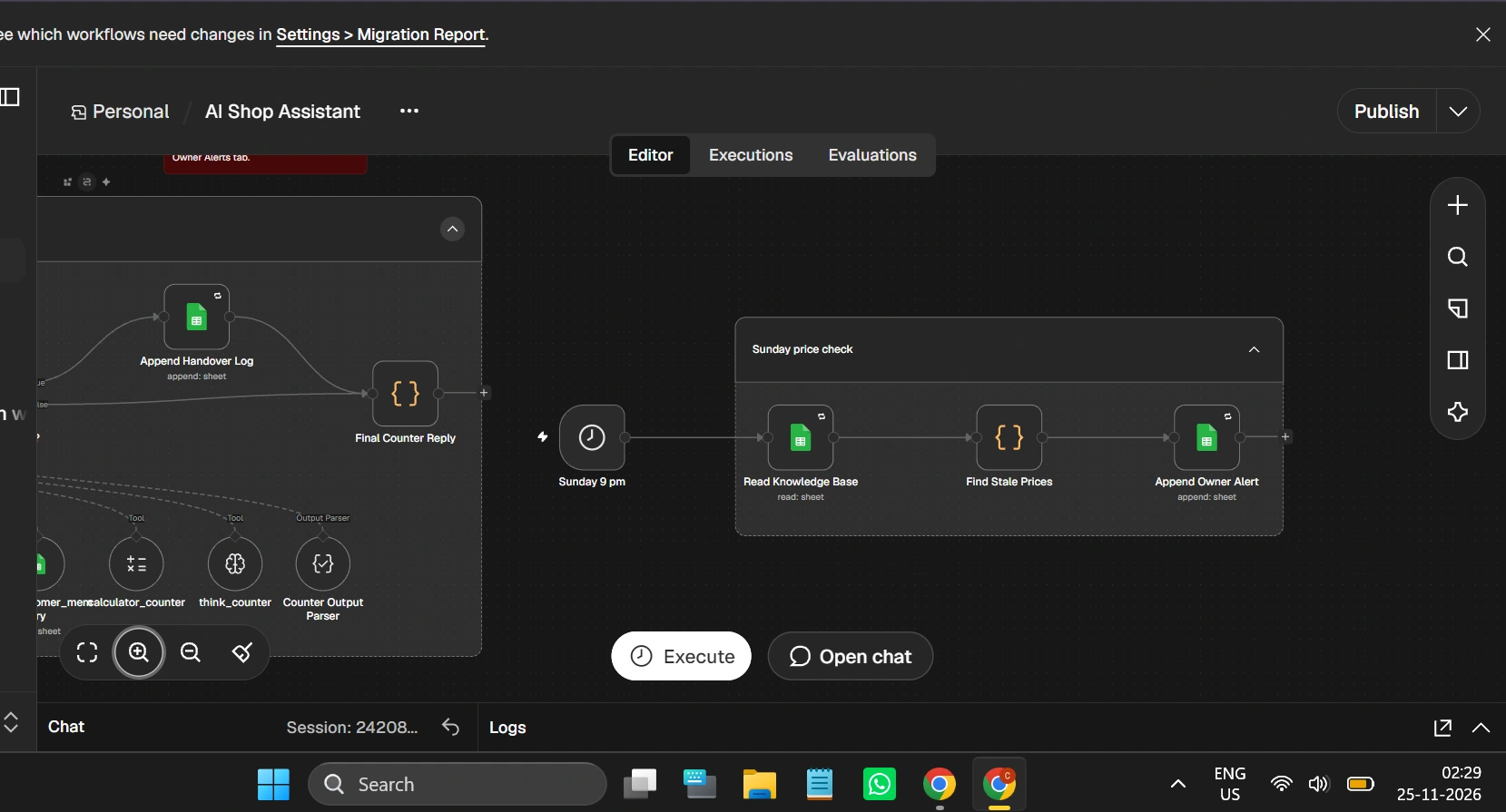
Old prices are the fastest way to lose trust in an assistant. The second part of the workflow runs every Sunday at 9 pm: it reads the Knowledge Base, finds any row in the prices and offers section that has not been updated for more than seven days, and writes an Owner Alert listing them. The owner corrects those rows before Monday morning.
Training new staff in weeks, not months
- Day one: where things are kept, how billing works, how to greet customers.
- Days two and three: the top ten products.
- By the end of week one: the owner’s explanation of each common product has been heard several times through the earpiece.
- After that: quiet questions during sales, plus a five-minute morning briefing before the shutter opens.
- Festival weeks: a short daily session on offers, low-stock items and what to suggest to each type of customer.
This is staff training that does not depend on the owner standing beside the new person all day.
Remembering regular customers
When a regular walks in, staff can see their usual purchases and notes before the customer reaches the counter, such as “prefers home delivery” or “needs GST invoices”. That small moment of being recognised is what keeps people coming back. The same customer list can also show which regulars have stopped visiting, through VIP repeat customer detection, and their usual purchases make cross-sell suggestions at billing more relevant.
The handover rule
The AI shop assistant never pretends to be a person. Customers are told it is a voice helper. Anyone who prefers a person can ask staff, and anything that needs judgment goes to a human every time. The Handover Log is worth reading weekly: questions that keep being handed over are the next rows to add to the Knowledge Base.
Choosing a voice for Indian counters
The assistant answers in the language the customer uses, with a fallback to the shop’s main local language when it is unsure. Its pace is calm, and the volume is low enough not to disturb other customers but clear over a ceiling fan. Only use a voice, the owner’s or a family member’s, with clear and explicit consent.
Mistakes worth avoiding
- Answers too long: trim them to counter length.
- Wrong voice picked up in a noisy shop: move the microphone closer to the counter.
- Old prices: act on the Sunday alert.
- Doing everything on day one: start with product answers, and add customer memory once staff are comfortable.
Staff start relying on the assistant when it is faster than shouting for the owner; that is the real test. Owners who are often away can combine it with a remote shop management app. My team builds the first version from the owner’s own answers and supports eligible beginners through Starter Support.

I am Radhakrishna, Founder and lead author at UpcomingTools.com, where I write Business Guides and Automation Guides for low investment automation in India. With 3 to 5 years offline experience serving small businesses only through trust and referrals, I now build software only workflows for lead follow up, bookings, quotes, stock, invoices and reporting and fix failed runs, expired tokens and unsafe AI and RAG answers. Every guide and workflow is written and decided by me, personally checked and live tested before publishing. I build in your own accounts on live, so your keys stay yours, show a rough demo before build and give 3 to 6 months free support with free tool help and ZERO SERVICE CHARGE for eligible starters.
7 Comments
[…] hear Hindi. I wrote about how we used the same owner-voice idea at a counter in the article on the AI shop assistant that trains staff in the owner’s voice, and the voice setup is the same […]
[…] The foundation of Sudarshan Rao’s system is the same idea we used in an earlier project, an AI shop assistant in the owner’s voice. It holds everything Rao garu knows about the store: product locations, prices, offers, supplier […]
[…] appears in our measurement error check for boutiques. Train new stylists on salon rules with an AI assistant in the owner’s voice, or with a Telegram helpdesk that answers staff voice notes. Clients who pay later can get a polite […]
[…] If your staff struggle to explain products when a customer asks about the suggested item, the AI shop assistant in the owner’s own voice gives them the owner’s answers. And for customers who pay by UPI at the counter, a daily QR […]
[…] it is written down. I have seen this more than once, and I wrote about the human side of it in the AI shop assistant built in the owner’s own voice. This build is the technical cousin of that […]
[…] Bundles sell faster around the dates people already shop, so keep a local festival calendar next to the Settings tab. If the queue at the counter is the bottleneck on busy days, see how one shop cut long billing lines, and teach new staff the one-line pitch with an AI assistant trained in the owner’s voice. […]
[…] should pair this with our remote shop management setup, and anyone training new boys can use an AI assistant trained in the owner’s voice. If phone orders keep the counter busy, see how one store cut long billing lines. Kitchens that […]