
About Us
The argument in favor of using filler text goes something like this: If you use real content in the Consulting Process, anytime you reach a review point you’ll end up reviewing and negotiating the content itself and not the design.
Scaling a Cake Recipe From 1 kg to 7.5 kg Without a Calculator
Scaling a Cake Recipe From 1 kg to 7.5 kg Without a Calculator
Bakery Recipe Scaling Automation With Baker’s Percentage
A cake that comes out perfect at 1 kg often fails at 5 kg, even when every ingredient was multiplied carefully. The reason is simple: some things do not scale in a straight line. Eggs come in whole pieces, leavening behaves differently in a deep pan, salt rounded to the nearest 5 g becomes a disaster, and the mixer has a limit. Bakery recipe scaling automation handles all of that from one command on the phone, using the method professional bakers already trust: baker’s percentage. It sits alongside the other kitchen and bakery setups in our restaurant automation guide.
Baker’s percentage in one table
In baker’s percentage, flour is always 100 and every other ingredient is written as a percentage of the flour weight. The recipe stops being a list of cups and becomes a ratio that works at any size.
Here is a tested 1 kg cake written both ways:
| Ingredient | Grams | Baker’s % |
|---|---|---|
| Flour | 250 | 100 |
| Sugar | 250 | 100 |
| Butter | 200 | 80 |
| Eggs, without shell | 250 | 100 |
| Milk | 60 | 24 |
| Baking powder | 8 | 3.2 |
| Salt | 2 | 0.8 |
| Total | 1,020 | 408 |
Everything must be in grams. A cup of flour weighs anywhere from 120 to 150 g depending on how it is filled, so a cup-based recipe has to be weighed once before it can be scaled.
Bake loss: why the batter must weigh more than the cake
This recipe makes 1,020 g of batter for a cake that weighs 1,000 g after baking and trimming. That gives a raw-to-finished ratio of 1.02. Every bakery’s ratio is different, because ovens, pans and recipes lose different amounts of moisture. So the ratio is measured once: weigh the batter, bake, trim, weigh the cake.
Bakery recipe scaling formulas, step by step
- Finished grams = cake size in kg × 1,000, or pieces × piece weight for cupcakes and cookies.
- Raw batter = finished grams × raw-to-finished ratio.
- Flour = raw batter × 100 ÷ sum of percentages.
- Every other ingredient = flour × its percentage ÷ 100.
Worked example for a 2.5 kg cake from the table above: raw batter = 2,500 × 1.02 = 2,550 g. Flour = 2,550 × 100 ÷ 408 = 625 g. Sugar 625 g, butter 500 g, baking powder 20 g, salt 5 g, and eggs 625 g.
Four things that refuse to scale straight
Eggs. 625 g of egg is 12.5 eggs at 50 g each. The automation rounds to 13 eggs, which is 650 g, and removes the extra 25 g from the milk, so 60 g × 2.5 = 150 g of milk becomes 125 g. Eggs are always weighed without the shell; an egg weighed in its shell is closer to 58 g, and using that weight leaves the cake short of egg and dry.
Leavening in big pans. Above about 3,000 g of finished cake, I multiply baking powder and soda by 0.9, because deep pans rise and dome differently. Both numbers live in a settings tab so each bakery can tune them.
Small ingredients. Flour rounds to the nearest 5 g, but salt and baking powder round to the nearest 1 g. Rounding salt to 5 g in a 3 kg batch gives 15 g instead of 8 g, which ruins the batch.
The mixer. Number of mixes = total batter ÷ mixer capacity, rounded up. A 7.5 kg order in a mixer that takes 6 kg becomes two equal mixes, not one overloaded bowl with unmixed flour at the bottom.
The bakery recipe scaling sheet behind the bot
The Google Sheet has four tabs. Recipes holds Recipe, Ingredient, Percent, Round To and, for eggs, Counted As and Grams Each. Recipe Settings holds the raw-to-finished ratio, piece weight, large-pan limit and factor, mixer maximum, pans per oven load, and the tested bake temperature and time. Pans and Equipment lists every pan with its batter weight. Batch Log records date, order, baker and the totals used, so the owner sees how much butter, flour and cocoa actually went out each week, which also feeds menu costing when ingredient prices rise.
Pan batter weights are measured, not guessed: fill each pan with water to the right depth and weigh it.
One command on Telegram
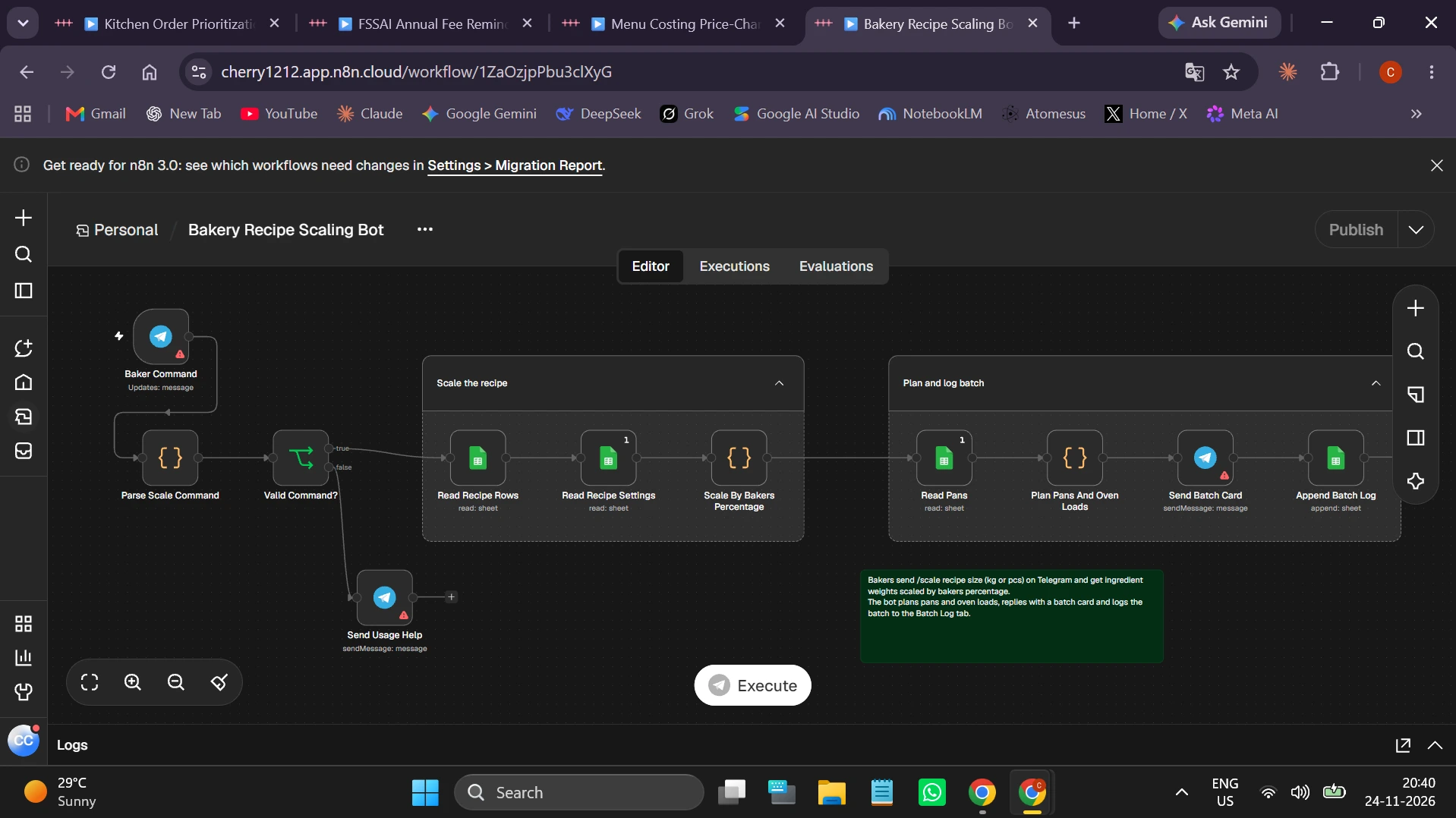
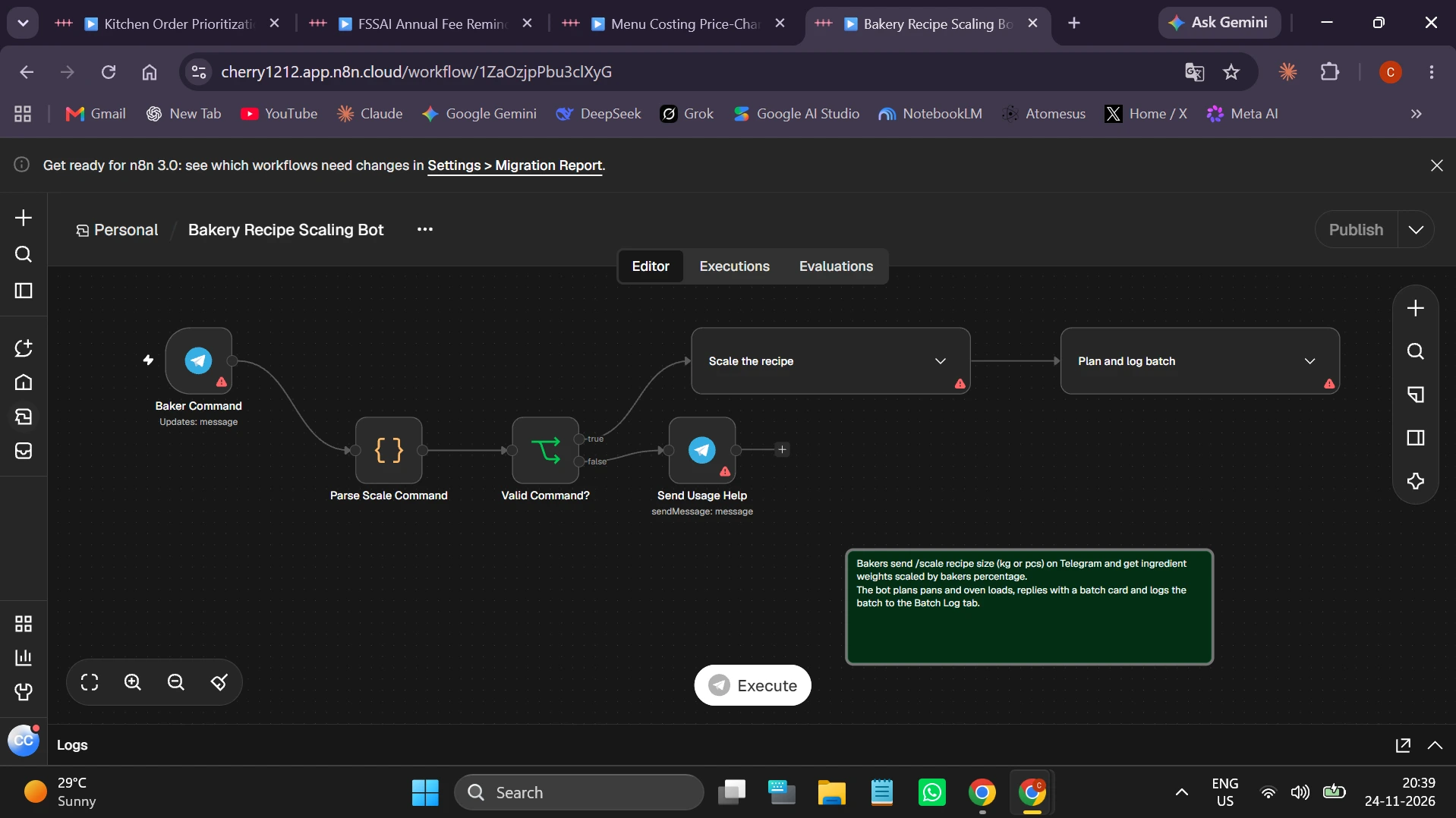
The baker types /scale black forest 7.5 for kilos or /scale chocolate cupcake 120pcs for pieces. In n8n, a Telegram Trigger receives the command, a Code node reads the recipe name, size and unit, and two Google Sheets nodes fetch the recipe rows and its settings. A scaling Code node runs the formulas above. A second Code node plans the pans, largest first, using a pan only while at least 80% of its batter is left, and marks the last one as part fill. It then counts oven loads. The reply comes back as a batch card that can be printed in A5.
If the name is misspelt, the bot asks “Did you mean black forest?” with a Yes button. If two recipes share a name, the sheet refuses the duplicate. The n8n documentation covers the Telegram and Google Sheets nodes used here.
A home baker working alone can skip n8n entirely and use the sheet with formulas, or add Apps Script and a Telegram bot at zero cost. A bakery already on Make, Zapier or Pabbly Connect can run the same maths in one code step.
Scaling down, and moving to a new oven
Scaling down is harder than scaling up. Tiny amounts are shown in spoons, for example 1 g of salt is about one-sixth of a teaspoon. When the egg works out to a fraction, beat one egg and weigh what the recipe needs. Below the mixer’s minimum load, mix by hand. For small pans under about 600 g, I start by cutting bake time by 20% and checking early.
A new oven gets one calibration bake at 1 kg. The difference in time becomes the Oven Factor, and every bake time is multiplied by it from then on.
Tests before a real order
| Command | What should come back |
|---|---|
| /scale black forest 1 | Exactly the tested 1 kg recipe |
| /scale black forest 0.5 | Half amounts, eggs rounded, milk adjusted |
| /scale black forest 7.5 | Two mixes and the large-pan baking powder rule |
| /scale vanilla cupcake 120pcs | Batter = 120 × piece weight × ratio |
| /scale unknown cake 2 | “Did you mean” or a clear error |
| /scale black forest abc | A usage message, no calculation |
Even after the tests pass, bake one small batch from the scaled numbers before taking a large order. Eggless versions are separate recipes with their own percentages, tested once at 1 kg.
Big festival orders are where bakery recipe scaling matters most, so it pairs well with a festival demand forecast made a few weeks ahead. Home bakers selling regularly should also have their FSSAI registration in place. My team usually sets this up by weighing every base recipe with the baker first, because the automation is only as good as the 1 kg recipe it starts from. If you have never built a workflow, automation without coding is a good first read.

I am Radhakrishna, Founder and lead author at UpcomingTools.com, where I write Business Guides and Automation Guides for low investment automation in India. With 3 to 5 years offline experience serving small businesses only through trust and referrals, I now build software only workflows for lead follow up, bookings, quotes, stock, invoices and reporting and fix failed runs, expired tokens and unsafe AI and RAG answers. Every guide and workflow is written and decided by me, personally checked and live tested before publishing. I build in your own accounts on live, so your keys stay yours, show a rough demo before build and give 3 to 6 months free support with free tool help and ZERO SERVICE CHARGE for eligible starters.
3 Comments
[…] the registration is done, the business side gets easier to plan. Home bakers can move on to scaling recipes with baker’s percentage for bigger orders, and sweet sellers can use festival demand forecasting to plan the season. If you […]
[…] to Production Plan with the raw material for each tray, using the same per-batch recipe amounts as bakery recipe scaling with baker’s percentage. A separate trigger watches the Pre-Orders tab for the 70% […]
[…] Google Sheets and Telegram bots are free, and there is no AI model in this setup, so there is no per-message charge. The only running cost is a small n8n server or a starter cloud plan. Bakeries use the same sheet with recipes per batch and a Pieces Per Batch column, which pairs naturally with scaling recipes by baker’s percentage. […]