
About Us
The argument in favor of using filler text goes something like this: If you use real content in the Consulting Process, anytime you reach a review point you’ll end up reviewing and negotiating the content itself and not the design.
Cross-Sell Automation and Counter Cross-Sell Suggestions From Your Own Bills
Cross-Sell Automation and Counter Cross-Sell Suggestions From Your Own Bills
Cross Selling vs Upselling at the Billing Counter: Automation From Your Own Sales Data
The billing counter is the last place a customer stands before leaving, and in most shops that moment is wasted. The cashier is busy, the line is long, and nobody remembers that people who buy a phone charger usually need a cable too. The customer walks out, finds the cable at home missing, and buys it somewhere else. Multiply that by a few hundred bills a week and it becomes real money that the shop already had within reach.
This guide explains cross selling vs upselling at a real counter, and how my team turns a shop’s own bills into one sensible suggestion at the counter: which pairs to trust, how the suggestion reaches the cashier in under a second, and how the shop learns which suggestions customers actually accept. It is part of our wider guide to automation in retail.
Cross selling vs upselling: which one belongs at the counter
The two ideas are often mixed up. Upselling moves the customer to a costlier version of what they already chose: the 5 kg pack instead of 1 kg, the better brand of the same item. Cross selling adds a different item that goes with the purchase: the cable with the charger, the stand with the plant pot, the batteries with the toy.
In the cross selling vs upselling choice, cross selling usually wins at a busy counter. The customer has already decided what to buy, and asking them to rethink that choice slows the line and feels like pressure. A related item, offered once, simply finishes the purchase. That is why our counter setup focuses on cross-sell pairs, and leaves upselling to the shelf and the product display, where customers decide at their own pace.
Cross sell analysis from 90 days of bills
Good suggestions do not come from guesses. They come from what customers in that shop have already bought together. The method is basket analysis, known in data science as association rule learning. For every pair of items, A and B, the workflow counts three things across the last 90 days of bill lines:
| Measure | What it tells you |
|---|---|
| Support | How often A and B appear in the same bill |
| Confidence | Of the bills with A, how many also had B |
| Lift | How much more likely B is when A is in the bill, compared with B on its own |
Lift is the one that matters. A lift close to 1 means the two items just happen to be popular, like rice and sugar. A lift well above 1 means buying A really does make B more likely.
Example, with illustrative numbers: out of 3,000 bills, 400 contain a phone charger and 60 of those also contain a cable. Confidence is 60 ÷ 400 = 15%. Cables appear in 5% of all bills, so lift is 15% ÷ 5% = 3.0. That is a strong pair.
A pair is kept only if the two items appear together in at least 20 bills and the lift is at least 1.2. Repeated lines of the same item in one bill count once, and returns and free items are left out, so a single bulk order or a giveaway cannot create a false pair.
Rules that keep suggestions sensible
Maths alone produces some silly pairs, so a few business rules sit on top:
- The suggested item must cost no more than three times the first item, so a ₹50 purchase never triggers a ₹500 suggestion.
- Items out of stock are never suggested.
- The owner keeps a short block list for pairs that are technically strong but wrong for the shop, such as a medicine paired with a sweet.
- A pair that customers keep refusing is dropped automatically, as explained further down.
How the workflow runs in n8n
The screenshot below is the working workflow, in three lanes. Each lane has one job, and the heavy counting never happens while a customer is waiting.
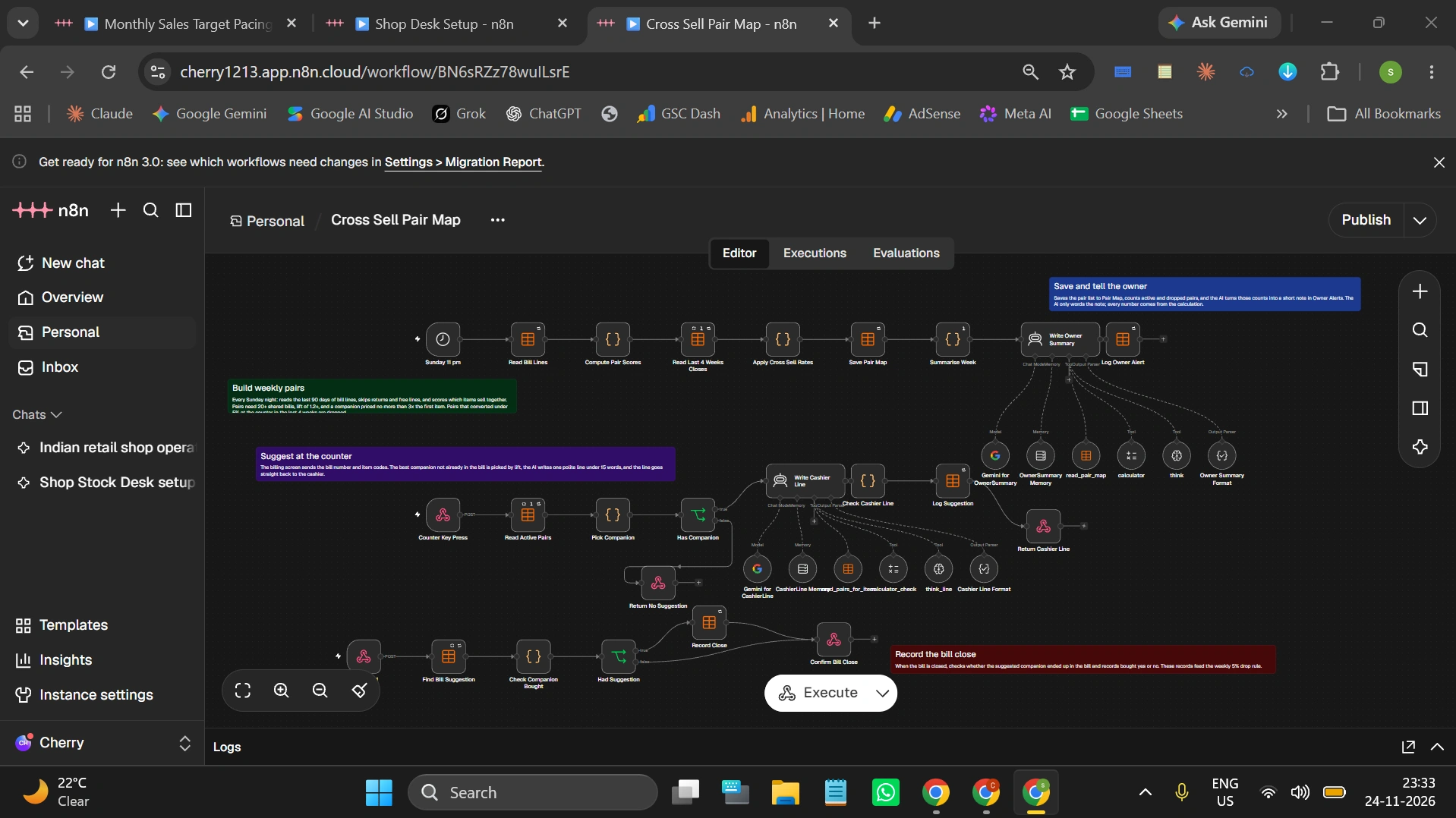
Lane 1, Sunday at 11 pm: build the pair map. The workflow reads the Bill Lines tab (Bill Number, Date, Item Code, Item, Category, Quantity, Price, Margin), scores every pair in a code step, and reads the last four weeks of bill closes to see which pairs customers actually accepted. It applies the cross-sell rates, saves the new Pair Map, and summarises the week. A Gemini AI agent then turns those numbers into a short note for the owner: how many pairs are active, which were dropped and why. The agent has memory and a read-only tool for the Pair Map, but every number in the note comes from the calculation; the AI only writes the sentences.
Lane 2, at the counter: suggest one item. When the cashier presses a key in the billing software, the bill number and item codes reach the workflow. It reads the active pairs, picks the companion with the highest lift that is not already in the bill, and checks there is a companion at all. If there is, a second Gemini agent writes one polite line under 15 words for the cashier, a check step confirms the line names the right item, the suggestion is logged, and the line goes straight back to the billing screen. If there is no good companion, the counter simply gets no suggestion.
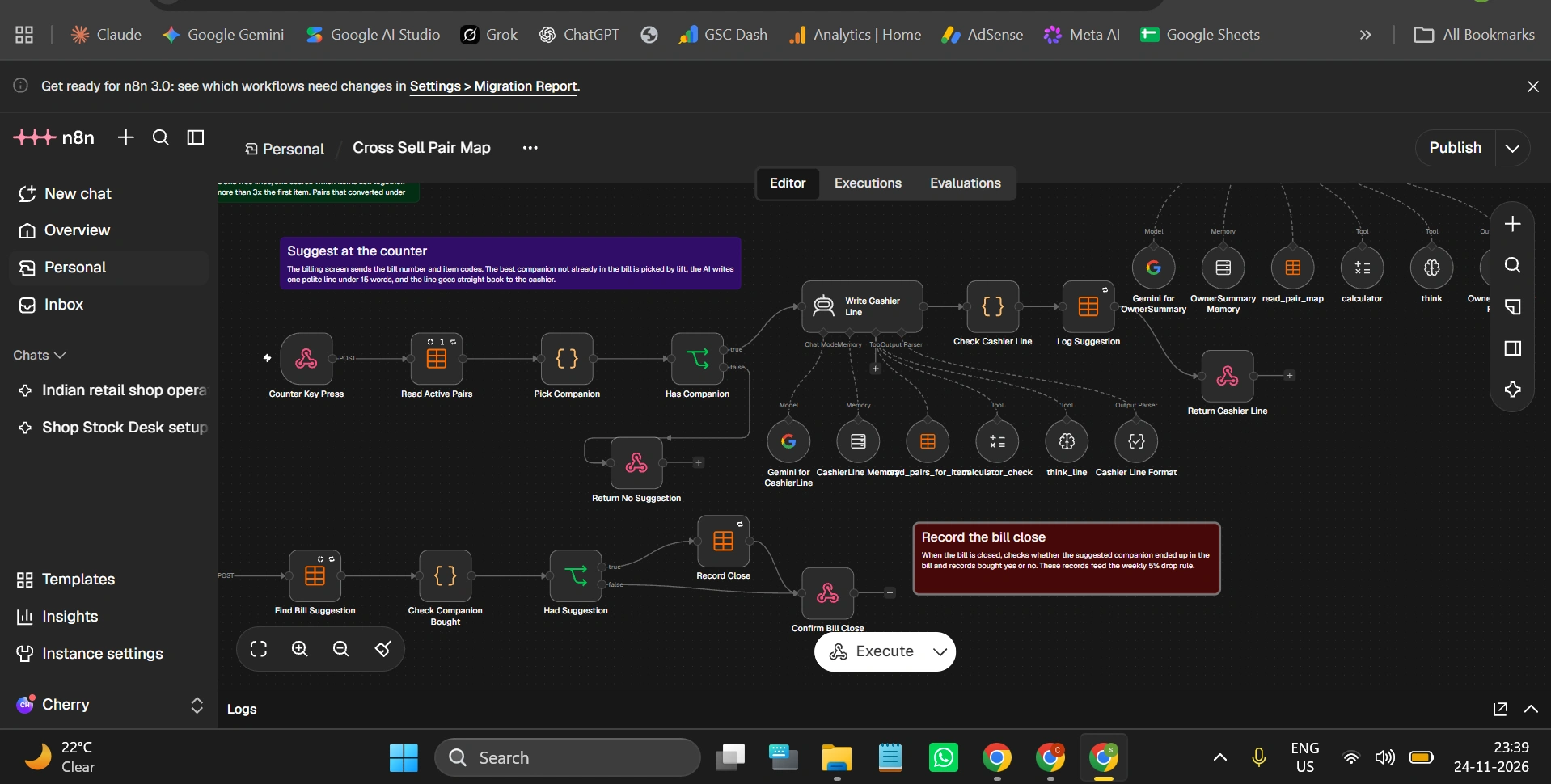
Lane 3, when the bill closes: record the result. The workflow finds the suggestion made for that bill, checks whether the companion ended up in the final bill, and records yes or no. These records are what the Sunday run uses to measure acceptance.
The n8n documentation covers the webhook, code, Google Sheets and AI Agent steps used here.
Measuring the cross-sell rate
Each pair gets its own cross-sell rate: suggestions accepted ÷ suggestions shown. Every Sunday, pairs below 5% acceptance over four weeks are dropped, and the owner sees them in the weekly note. In practice, the first month removes the pairs that look good on paper but feel odd to customers, and what remains is a short list of suggestions that genuinely help.
The same rate is the honest answer to “is this working?”. If the rate across all pairs stays low, the problem is usually not the maths but how the line is said at the counter.
Testing before the counter sees anything
For the first two weeks, suggestions appear only on the owner’s laptop, not at the counter. This shadow run is where strange pairs show up, such as batteries suggested with a toy that already includes them. The owner adds those to the block list before anything reaches a customer.
Making it work at the counter
- One suggestion at a time, never a list.
- The cashier says the line once, in their own language, and accepts a no without pushing.
- A small rack beside each counter holds the 20 most-suggested companion items, refilled each morning from the suggestion log, so the item is in reach when the customer says yes.
The same logic suits online shops too. In cross selling ecommerce, the suggestion appears on the product page or in the cart instead of the cashier’s screen, but the pairs, the lift and the acceptance rate work the same way.
Where this fits with the rest of the shop
Getting cross selling vs upselling right at the counter is one way to grow the average bill; bringing back regular customers is another, which is what VIP repeat customer detection does. Both show up quickly in monthly sales target pacing. Shorter lines also give cashiers time to say the line at all, which is why many shops pair this with a queue management system on their existing CCTV. My team sets up a free sheet-based version for eligible beginners through Starter Support.

I am Radhakrishna, Founder and lead author at UpcomingTools.com, where I write Business Guides and Automation Guides for low investment automation in India. With 3 to 5 years offline experience serving small businesses only through trust and referrals, I now build software only workflows for lead follow up, bookings, quotes, stock, invoices and reporting and fix failed runs, expired tokens and unsafe AI and RAG answers. Every guide and workflow is written and decided by me, personally checked and live tested before publishing. I build in your own accounts on live, so your keys stay yours, show a rough demo before build and give 3 to 6 months free support with free tool help and ZERO SERVICE CHARGE for eligible starters.
5 Comments
[…] also the ones most likely to accept a sensible suggestion, so VIP detection pairs naturally with cross-sell suggestions at the billing counter. Bringing back even a few drifting VIPs each week shows up quickly in monthly sales target pacing. […]
[…] lines also help the rest of the counter work: there is time to make one sensible cross-sell suggestion at billing, and fewer regular customers walk out and quietly drift away, which VIP repeat customer detection […]
[…] few drifting regulars from VIP repeat customer detection often closes a small gap within days, and cross-sell suggestions at the billing counter lift the average bill without extra footfall. Owners who are away from the shop can receive the […]
[…] have stopped visiting, through VIP repeat customer detection, and their usual purchases make cross-sell suggestions at billing more […]
[…] be checked before they lock up more cash. Counter slots work best for items that also appear in cross-sell suggestions at billing. When my team sets this up, the first job is walking the shop with the owner to number every shelf. […]